

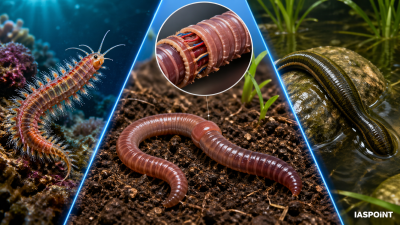
Phylum Annelida, derived from the Latin annulus (little ring), represents the most evolved group of worms. These organisms are characterized by a segmented body structure, which marks a significant evolutionary milestone in animal complexity. They inhabit diverse environments, including marine water (e.g., Nereis), freshwater (e.g., Hirudinaria), and damp terrestrial soil (e.g., Earthworms).
Morphological and Anatomical Characteristics
Metameric Segmentation
The most defining feature of Annelids is metamerism. The body is externally and internally divided into segments called metameres or somites. This segmentation allows for more localized muscle contraction and specialized movement.
Symmetry and Germ Layers
- Triploblastic and Bilateral: Annelids are triploblastic (three germ layers) and exhibit bilateral symmetry.
- True Coelomates: They are the first group of animals to possess a true coelom (a body cavity entirely lined by mesoderm). The coelomic fluid acts as a hydrostatic skeleton.
Physiological Systems
- Digestive System: A complete alimentary canal is present, with specialized regions like the pharynx, esophagus, crop, gizzard (for grinding), and intestine.
- Circulatory System: Most annelids possess a closed circulatory system, meaning blood flows through distinct vessels. They are the first phylum to develop this. Earthworms, for instance, have “lateral hearts” and respiratory pigments like hemoglobin dissolved in the plasma.
- Respiratory System: There are no specialized respiratory organs. Gaseous exchange occurs through the moist skin (cutaneous respiration) or through parapodia in some marine forms.
- Excretory System: Specialized coiled tubes called Nephridia are present for osmoregulation and the excretion of nitrogenous wastes.
- Nervous System: Consists of paired ganglia (primitive brain) connected by a double ventral nerve cord with segmental ganglia.
Locomotion and Movement
Annelids possess longitudinal and circular muscles that facilitate movement.
- Setae (Chaetae): S-shaped chitinous structures found in earthworms that help in gripping the soil.
- Parapodia: Lateral appendages found in marine annelids like Nereis, used for swimming and respiration.
- Suckers: Found in leeches for attachment and locomotion.
Classification of Annelida
| Class | Habitat | Locomotory Organs | Example | Key Feature |
| Polychaeta | Mostly Marine | Parapodia with many setae | Nereis (Sandworm) | Distinct head with eyes and tentacles. |
| Oligochaeta | Terrestrial/Freshwater | Setae (few) | Pheretima (Earthworm) | Hermaphrodites; clitellum present. |
| Hirudinea | Freshwater/Ectoparasitic | Suckers (Setae absent) | Hirudinaria (Cattle Leech) | Anticoagulant (Hirudin) in saliva. |
Reproduction and Development
- Sexuality: Annelids can be either dioecious (separate sexes, e.g., Nereis) or monoecious/hermaphrodites (bisexual, e.g., Earthworms and Leeches).
- Fertilization: External in Nereis; internal/cross-fertilization in earthworms.
- Development: May be direct (Earthworms) or indirect via a specialized larval stage called the Trochophore larva.
UPSC Prelims: Essential Facts and Trivia
Ecological and Economic Importance
- “Friends of Farmers”: Earthworms improve soil fertility by aerating the soil through burrowing and decomposing organic matter into nutrient-rich vermicompost.
- Vermiculture: The scientific process of breeding earthworms to convert organic waste into fertilizer.
- Hirudin: A powerful anticoagulant secreted by leeches to prevent blood clotting while they feed. It is used in modern medicine to treat blood clots and in microsurgery.
Evolutionary Landmarks
- First Coelomates: Evolution of the true body cavity.
- First Closed Circulatory System: Evolution of blood vessels.
- Metamerism: First appearance of true body segmentation.
Comparative Summary: Flatworms vs. Roundworms vs. Annelids
| Feature | Platyhelminthes | Nematoda | Annelida |
| Body Shape | Dorso-ventrally flat | Cylindrical | Segmented/Ringed |
| Coelom | Acoelomate | Pseudocoelomate | Coelomate |
| Digestive System | Incomplete | Complete | Complete |
| Circulation | Absent | Absent | Closed System |
| Excretion | Flame Cells | Renette Cells | Nephridia |