

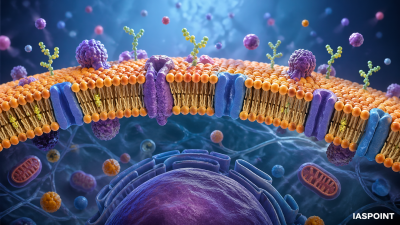
The cell membrane, also known as the Plasma Membrane, is a thin, delicate, and selectively permeable living boundary that encloses the cytoplasm of all cells.
Structural Model: The Fluid Mosaic Model
Proposed by S.J. Singer and G.L. Nicolson in 1972, this is the most widely accepted model describing the membrane’s structure.
- Phospholipid Bilayer: The membrane consists of a double layer of phospholipids. Each molecule has a Hydrophilic (water-attracting) head facing outward and a Hydrophobic (water-repelling) tail facing inward.
- Proteins: These are “moasics” embedded in the lipid bilayer.
- Integral Proteins: Span the entire membrane; act as channels or pumps.
- Peripheral Proteins: Attached to the surface; serve as receptors or enzymes.
- Cholesterol: Tucked between phospholipids, it maintains membrane fluidity and stability across varying temperatures.
- Carbohydrates: Attached to proteins (Glycoproteins) or lipids (Glycolipids), they are crucial for Cell Recognition (how the immune system identifies “self” vs. “non-self”).
Key Functions of the Plasma Membrane
- Selective Permeability: It regulates the entry and exit of molecules. Small non-polar molecules (like O2 and CO2) pass easily, while ions and large polar molecules require specialized transport proteins.
- Protection and Support: Maintains the cell’s integrity and provides a fixed environment inside the cell.
- Communication: Contains receptors that bind to hormones and neurotransmitters, triggering internal cellular responses.
- Cell Signaling: Essential for coordinating activities in multicellular organisms.
Mechanisms of Membrane Transport
Transport across the membrane is categorized based on energy expenditure:
| Transport Type | Energy (ATP) Required? | Mechanism | Examples |
| Simple Diffusion | No (Passive) | Movement from high to low concentration. | O2 and CO2 exchange in lungs. |
| Osmosis | No (Passive) | Diffusion of water through a semi-permeable membrane. | Water absorption by plant roots. |
| Facilitated Diffusion | No (Passive) | Use of carrier/channel proteins for larger molecules. | Glucose transport into cells. |
| Active Transport | Yes (Active) | Movement against concentration gradient (low to high). | Sodium-Potassium Pump (Na^+/K^+ pump). |
| Endocytosis | Yes (Active) | Membrane engulfs external particles. | Amoeba feeding; White Blood Cells engulfing bacteria. |
Specialized Processes: Endocytosis and Exocytosis
- Phagocytosis (Cell Eating): The intake of solid particles (e.g., immune cells destroying pathogens).
- Pinocytosis (Cell Drinking): The intake of extracellular fluid and dissolved substances.
- Exocytosis: The process by which cells expel waste or secrete substances (like enzymes and hormones) in vesicles.
Facts and Trivia for UPSC Prelims
- Semi-permeable vs. Selectively Permeable: A semi-permeable membrane allows only solvent (water) to pass, whereas the cell membrane is selectively permeable because it chooses which solutes (ions/nutrients) can cross.
- Lipid Composition: The fluidity of the membrane is determined by the ratio of saturated to unsaturated fatty acids. Higher unsaturated fat content keeps membranes fluid in cold environments.
- The Glycocalyx: This “sugar coating” on the outside of the cell membrane is vital for tissue histocompatibility and organ transplant rejection.
- Target of Toxins: Many snake venoms contain enzymes (phospholipases) that digest the phospholipids of the cell membrane, causing cell rupture and tissue death.
- Homeostasis: The membrane is the primary organelle responsible for maintaining the “steady state” of the cell’s internal chemistry.
Difference from Cell Wall
| Feature | Cell Membrane | Cell Wall |
| Nature | Living, thin, and flexible. | Non-living, thick, and rigid. |
| Presence | All living cells (Plant and Animal). | Only in Plants, Fungi, and Bacteria. |
| Function | Controls transport and signaling. | Provides structural support and protection. |
| Permeability | Selectively Permeable. | Freely Permeable (to most molecules). |