

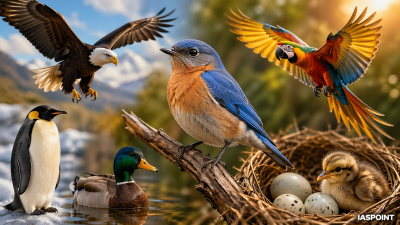
Class Aves comprises endothermic vertebrates characterized by feathers, toothless beaked jaws, and the laying of hard-shelled eggs.
Evolutionary Lineage and Biological Classification
Birds are categorized under the Phylum Chordata and Subphylum Vertebrata. Modern biological consensus identifies them as specialized theropod dinosaurs, making them the only surviving lineage of dinosaurs following the Cretaceous-Paleogene extinction event.
- Kingdom: Animalia
- Phylum: Chordata
- Class: Aves
- Study of Birds: Ornithology
Physiological and Anatomical Adaptations for Flight
To facilitate flight, birds have evolved specific anatomical features that minimize weight and maximize power output.
Skeletal and Muscular System
- Pneumatic Bones: Most birds possess hollow bones with air cavities, significantly reducing body weight without compromising structural integrity.
- Keeled Sternum: The breastbone (sternum) features a large ridge called a keel, which serves as an attachment point for powerful flight muscles (pectoralis).
- Furcula: Commonly known as the wishbone, it acts as a spring to maintain skeletal rigidity during the wing stroke.
Respiratory and Circulatory Systems
- Double Respiration: Birds possess an efficient respiratory system with air sacs that ensure a continuous flow of oxygenated air through the lungs during both inhalation and exhalation.
- Four-Chambered Heart: Similar to mammals, birds have a completely separated four-chambered heart, preventing the mixing of oxygenated and deoxygenated blood and supporting high metabolic rates.
Distinctive Biological Traits
| Feature | Description |
| Endothermy | Commonly known as “warm-blooded,” birds maintain a constant internal body temperature regardless of the environment. |
| Uricotelic Excretion | To conserve water and reduce weight, birds excrete nitrogenous waste as uric acid (a thick white paste) rather than liquid urine. |
| Syrinx | Unlike the mammalian larynx, birds use a specialized vocal organ called the syrinx located at the base of the trachea to produce sound. |
| Vision | Highly developed; most birds possess tetrachromatic vision, allowing them to see ultraviolet light. |
Reproductive Biology
All birds are oviparous (egg-laying). The eggs are cleidoic, meaning they are protected by a calcareous shell that allows for gas exchange while preventing desiccation.
- Brood Parasitism: A specialized reproductive strategy where certain birds, such as the Cuckoo (Koel), lay eggs in the nests of other species, leaving the host to raise the offspring.
- Nesting Behavior: Varies from simple scrapes on the ground to complex woven structures (e.g., Baya Weaver).
Classification Based on Flight Ability
Birds are broadly divided based on their ability to fly, which is often linked to the structure of their sternum.
Ratites (Flightless Birds)
These birds lack a keeled sternum. Evolutionarily, they adapted to terrestrial niches where flight was not a primary requirement for survival.
- Examples: Ostrich (Africa), Kiwi (New Zealand), Emu (Australia), Cassowary (New Guinea), and Rhea (South America).
Carinates (Flying Birds)
These possess a keeled sternum (carina) to support flight muscles. This group includes the vast majority of modern bird species.
- Examples: Raptors (Eagles, Falcons), Passerines (Songbirds), and Waterfowl (Ducks, Swans).
Key Ecological Roles and Indian Context
Birds play a critical role in maintaining ecological balance through various functions:
- Pollination: Sunbirds and Hummingbirds are essential pollinators for many flora species.
- Seed Dispersal: Frugivorous birds (fruit-eaters) like Hornbills are often referred to as “Farmers of the Forest.”
- Scavenging: Vultures act as nature’s cleaners, disposing of carcasses and preventing the spread of diseases like anthrax and rabies.
Important Facts for UPSC Prelims
- State Bird of India: The Indian Peafowl (Pavo cristatus).
- The Birdman of India: Salim Ali, a pioneering ornithologist whose work laid the foundation for bird conservation in India.
- Largest Bird: The North African Ostrich.
- Smallest Bird: The Bee Hummingbird (native to Cuba).
- Fastest Bird: The Peregrine Falcon, capable of reaching speeds over 320 km/h during its characteristic hunting stoop.
- Migratory Flyways: India lies at the heart of the Central Asian Flyway (CAF), a major migratory route for birds traveling from the Arctic to the Indian Ocean.