

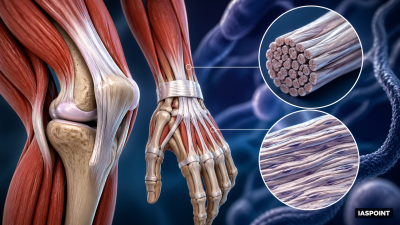
In the musculoskeletal system, tendons and ligaments are specialized forms of dense regular connective tissue. They are composed primarily of collagen fibers arranged in parallel bundles, providing the high tensile strength necessary to withstand the mechanical stresses of movement.
Tendons: The Muscle-Bone Interface
Tendons serve as the vital link that transmits the force of muscle contraction to the bone, enabling movement of the skeleton.
- Primary Function: Connects Skeletal Muscle to Bone.
- Composition: Primarily composed of Type I Collagen fibers and specialized cells called Tenocytes.
- Elasticity: Relatively inelastic compared to ligaments, ensuring that the force generated by muscles is efficiently transferred to the bone for movement.
- Structure: They are tough, inelastic, white fibrous tissues.
- Example: The Achilles Tendon, which connects the calf muscles to the heel bone, is the thickest and strongest tendon in the human body.
Ligaments: The Bone-Bone Interface
Ligaments act as biological “straps” that stabilize joints and prevent bones from moving in ways that could cause injury.
- Primary Function: Connects Bone to Bone.
- Composition: Contains collagen fibers mixed with a higher proportion of Elastic fibers (elastin).
- Elasticity: More elastic than tendons, allowing joints to flex and extend while maintaining structural alignment.
- Structure: Strong, elastic, yellow fibrous tissues.
- Example: The Anterior Cruciate Ligament (ACL) in the knee, which prevents the tibia from sliding out in front of the femur.
Comparative Analysis for UPSC Prelims
Distinguishing between these two tissues is a frequent requirement in biological classification questions.
| Feature | Tendons | Ligaments |
| Connection | Muscle to Bone. | Bone to Bone. |
| Tissue Type | White Fibrous Tissue. | Yellow Elastic Tissue. |
| Flexibility | Limited/Inelastic. | Highly Elastic. |
| Function | Transmit force for movement. | Provide joint stability; prevent dislocation. |
| Fibres | Parallel bundles of collagen. | Compact but less regular collagen + elastin. |
Mechanism of Action
- Synergy in Movement: When a muscle contracts, the Tendon pulls the bone. Simultaneously, the Ligaments at the joint act as stabilizers to ensure the bones stay within their proper range of motion.
- Proprioception: Both tendons and ligaments contain sensory receptors (like Golgi tendon organs) that send feedback to the brain regarding the position and tension of the limbs.
Clinical Pathologies and Injuries
Understanding the terminology of injuries is essential for general science sections.
- Strain: An injury to a Tendon or the muscle itself, usually caused by overstretching or over-contraction.
- Sprain: An injury to a Ligament, typically resulting from a sudden twist or wrenching of a joint (e.g., a “sprained ankle”).
- Tendonitis: Inflammation of a tendon, often due to repetitive stress or overuse.
- Ligamentous Laxity: A condition where ligaments are “loose,” leading to hypermobile joints and an increased risk of dislocations.
Essential Facts for Aspirants
- Vascularity: Like cartilage, both tendons and ligaments have a poor blood supply compared to muscle and bone. Consequently, they heal very slowly after an injury.
- Sharpey’s Fibres: These are the specific collagen fibers that anchor the tendons or ligaments into the Periosteum (outer layer) of the bone, ensuring a secure attachment.
- Yellow vs. White: Ligaments are often referred to as “yellow” due to the presence of elastin, whereas tendons are “white” due to the dominance of collagen.