

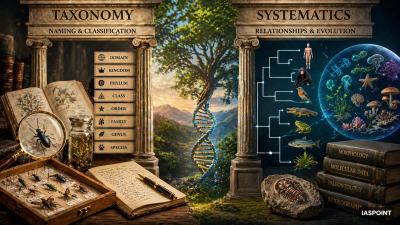
Taxonomy and Systematics are the foundational pillars of biological classification. While often used interchangeably, they represent distinct scientific methodologies. Taxonomy focuses on the rules and principles of naming and classifying organisms, whereas Systematics encompasses taxonomy and adds the study of evolutionary relationships (phylogeny).
Fundamental Components of Taxonomy
Taxonomy operates through three primary processes that ensure every organism is uniquely identifiable:
- Characterization: The detailed description of the morphological, anatomical, and genetic traits of a specimen.
- Identification: Matching the characteristics of an unknown organism with those of already known species to determine its identity.
- Classification: Grouping organisms into hierarchical categories based on similarities and differences.
- Nomenclature: Providing a scientific name to the organism according to internationally accepted rules.
Binomial Nomenclature
Introduced by Carl Linnaeus (the Father of Modern Taxonomy) in his work Systema Naturae, this system provides a two-part scientific name to every species.
- Generic Name: The first word, representing the Genus, always capitalized (e.g., Homo).
- Specific Epithet: The second word, representing the species, in lowercase (e.g., sapiens).
- Rules: Names are derived from Latin or Greek. When handwritten, they are underlined separately; when printed, they are italicized.
Taxonomic Hierarchy
Living organisms are organized into a descending series of categories called taxa (singular: taxon). As one moves down the hierarchy from Kingdom to Species, the number of common characteristics increases, while the number of individuals decreases.
| Taxonomic Level | Key Characteristics | Examples (Human / Mango) |
| Kingdom | Highest level; broad classification based on cell structure and nutrition. | Animalia / Plantae |
| Phylum / Division | Grouping based on fundamental structural features (Division is used for plants). | Chordata / Angiospermae |
| Class | Includes related orders with shared specialized traits. | Mammalia / Dicotyledonae |
| Order | A collection of families exhibiting a few similar characters. | Primata / Sapindales |
| Family | Group of related genera with less similarity than genus. | Hominidae / Anacardiaceae |
| Genus | A group of species which are similar in broad features. | Homo / Mangifera |
| Species | The basic unit of classification; individuals can interbreed. | sapiens / indica |
Tools for Taxonomic Studies
Taxonomists use various “taxonomic aids” to store and preserve information and specimens for future reference:
- Herbarium: A storehouse of collected plant specimens that are dried, pressed, and preserved on sheets.
- Botanical Gardens: Collections of living plants for identification and educational purposes (e.g., Royal Botanical Garden, Kew; Indian Botanical Garden, Howrah).
- Museums: Collections of preserved plant and animal specimens for study; insects are kept in insect boxes after pinning.
- Zoological Parks: Enclosures where wild animals are kept in protected environments under human care.
- Key: A tool used for identification based on contrasting characters, usually in a pair called a couplet. Each statement in the key is called a lead.
Modern Trends in Systematics
With advancements in molecular biology, the scope of systematics has expanded beyond mere morphology:
- Cytotaxonomy: Classification based on cytological information like chromosome number, structure, and behavior.
- Chemotaxonomy: Uses the chemical constituents of plants (e.g., DNA sequence, proteins, alkaloids) to resolve taxonomic confusion.
- Numerical Taxonomy: Utilizes mathematical methods and computers to analyze hundreds of observable characteristics simultaneously.
- Phylogenetic Classification: Based on evolutionary relationships, assuming that organisms belonging to the same taxa have a common ancestor.
Important Facts and Trivia for UPSC Prelims
- ICBN & ICZN: International Code of Botanical Nomenclature and International Code of Zoological Nomenclature are the governing bodies for naming plants and animals respectively.
- The Five Kingdom System: Proposed by R.H. Whittaker (1969), it remains the most widely accepted classification (Monera, Protista, Fungi, Plantae, Animalia).
- Three Domains of Life: Carl Woese proposed a level higher than Kingdom based on 16S ribosomal RNA sequences, dividing life into Archaea, Bacteria, and Eukarya.
- Type Specimen: The original specimen based on which the description of a new species is published is called the Holotype.
- Tautonyms: When the generic name and specific epithet are identical (e.g., Naja naja for Cobra). Note: Tautonyms are valid in zoology but not in botany.