

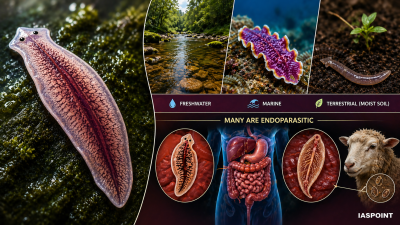
Phylum Platyhelminthes, derived from the Greek platys (flat) and helmins (worm), comprises organisms commonly known as flatworms. These are the simplest animals exhibiting bilateral symmetry and triploblastic development. They occupy diverse habitats, ranging from freshwater and marine environments to moist terrestrial soils, while a significant number are endoparasitic, living inside human beings and other animals.
Morphological and Anatomical Characteristics
Body Flattening and Symmetry
Flatworms possess a dorso-ventrally flattened body, which is the primary reason for their nomenclature. They exhibit bilateral symmetry, meaning the body can be divided into identical left and right halves along a single plane. This evolutionary trait is often associated with cephalization—the concentration of nerve tissue and sensory organs at the anterior (head) end.
Germ Layers and Body Cavity
- Triploblastic Development: They are the first group of animals to evolve three distinct germ layers: the ectoderm, mesoderm, and endoderm.
- Acoelomate Nature: Despite being triploblastic, they lack a body cavity (coelom). The space between the body wall and the digestive tract is filled with a specialized connective tissue called parenchyma or mesenchyma.
Physiological Systems
- Digestive System: Generally incomplete, meaning there is only a single opening that serves as both mouth and anus. In parasitic forms like tapeworms, the digestive system is entirely absent as they absorb nutrients directly through their body surface.
- Excretory System: Characterized by specialized cells called Flame Cells (Protonephridia). These cells facilitate osmoregulation and the excretion of nitrogenous wastes.
- Respiratory and Circulatory Systems: Flatworms lack formal respiratory and circulatory systems. Gaseous exchange occurs through simple diffusion across the body surface.
- Nervous System: Typically “ladder-like,” consisting of a pair of anterior ganglia (brain) and longitudinal nerve cords connected by transverse nerves.
Classification of Platyhelminthes
| Class | Common Name | Habitat/Mode of Life | Key Features | Examples |
| Turbellaria | Planarians | Mostly free-living; aquatic | Ciliated epidermis; high regeneration power | Dugesia (Planaria) |
| Trematoda | Flukes | Ecto or Endoparasitic | Thick cuticle; presence of suckers for attachment | Fasciola hepatica (Liver fluke) |
| Cestoda | Tapeworms | Endoparasitic in gut | Segmented body (proglottids); lacks digestive tract | Taenia solium (Pork tapeworm) |
Reproduction and Life Cycle
Reproductive Mechanisms
Most flatworms are hermaphrodites (monoecious), possessing both male and female reproductive organs in a single individual. Fertilization is usually internal. Asexual reproduction is prominent in free-living forms like Planaria, which exhibit a remarkable capacity for regeneration from fragmented body parts.
Complex Life Cycles in Parasites
Parasitic Platyhelminthes often involve one or more intermediate hosts to complete their life cycle. For instance, the Liver Fluke (Fasciola) requires a snail as an intermediate host, while the Pork Tapeworm (Taenia) utilizes pigs as intermediate hosts before infecting humans.
UPSC Prelims: Essential Facts and Trivia
Biological Significance
- First Triploblastic Animals: They mark a significant evolutionary step from the diploblastic nature of Coelenterates.
- Cephalization: The emergence of a defined “head” region with sensory structures like eyespots (in Planaria) begins with this phylum.
- Hooks and Suckers: Parasitic forms possess specialized attachment organs to anchor themselves to the host’s intestinal wall or tissues.
Common Diseases and Pathogens
- Schistosomiasis (Bilharzia): Caused by blood flukes (Schistosoma), it is a major tropical disease second only to malaria in economic impact.
- Taeniasis: An intestinal infection caused by adult tapeworms, usually contracted by consuming undercooked meat containing cysticerci (larval stage).
- Cysticercosis: A more severe condition occurring when humans ingest Taenia solium eggs, leading to larvae developing in muscles or the brain (Neurocysticercosis).
Summary for Revision
- Level of Organization: Organ-system level.
- Symmetry: Bilateral.
- Coelom: Acoelomate.
- Excretion: Flame cells (Protonephridia).
- Unique Trait: Dorso-ventral flattening and high regeneration (Planaria).