

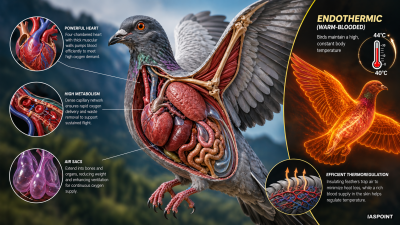
The physiology of birds is defined by the necessity of sustaining flight, which is the most energy-demanding form of locomotion. Birds are endothermic (warm-blooded) and maintain a high, constant body temperature, usually ranging between 40°C and 44°C.
Thermoregulation and Metabolism
Birds have the highest metabolic rates among all vertebrates. This high metabolism is essential for generating the heat required for endothermy and the energy required for flight.
- Basal Metabolic Rate (BMR): Small birds, such as hummingbirds, have exceptionally high BMRs, requiring them to consume more than their body weight in food daily.
- Torpor: Some small birds (e.g., Hummingbirds, Swifts) can enter a state of “daily torpor” at night—a temporary drop in body temperature and metabolic rate to conserve energy.
- Heat Dissipation: Lacking sweat glands, birds cool down through panting (gular fluttering) and by adjusting their feathers to allow air to reach the skin.
Respiratory Physiology: The Efficiency of Air Sacs
The avian respiratory system is unique because it separates the ventilation of the lungs from the gas exchange process.
- Continuous Flow: Unlike the “tidal” breathing of mammals (where air goes in and out the same path), birds use a unidirectional flow system.
- The Two-Cycle Breath: It takes two full cycles of inhalation and exhalation for a single “packet” of air to move through the entire system.
- Gas Exchange: This occurs in the parabronchi of the lungs. The blood flows in the opposite direction to the air (cross-current flow), which is highly efficient at extracting oxygen even at high altitudes where oxygen pressure is low.
Circulatory Physiology
To support high metabolic activity, the avian circulatory system is built for high-volume and high-pressure transport.
- Cardiac Output: Birds have larger hearts relative to their body size compared to mammals.
- Blood Pressure: They maintain significantly higher arterial blood pressure than most mammals.
- Red Blood Cells (RBCs): Unlike mammals, avian RBCs are oval and nucleated. While mammalian RBCs lack a nucleus to carry more hemoglobin, avian RBCs compensate with high turnover and efficient lung loading.
Excretory and Osmoregulatory Physiology
Birds must manage water balance and nitrogenous waste while minimizing weight.
- Uricotelism: Excreting nitrogenous waste as uric acid is a crucial physiological adaptation. It requires very little water to eliminate, preventing dehydration and reducing the weight of stored liquid.
- Salt Glands: Marine birds (e.g., Albatrosses, Gulls) possess specialized supraorbital glands located above the eyes. these glands filter excess salt from the blood, which is then excreted through the nostrils. This allows them to “drink” seawater.
Sensory Physiology: Vision and Magnetoreception
- Vision: Birds possess the most sophisticated visual system of any vertebrate. Many are tetrachromatic, possessing a fourth retinal cone for ultraviolet (UV) light, which helps in identifying ripe fruits or the urine trails of prey.
- Magnetoreception: Many migratory birds possess a “biological compass.” This involves iron-oxide (magnetite) in the beak or specialized proteins called cryptochromes in the eyes that allow them to perceive the Earth’s magnetic field for navigation.
Reproductive Physiology
- Photoperiodism: Most birds are seasonal breeders. Their reproductive organs (gonads) actually shrink during the non-breeding season to save weight and regrow in response to increasing daylight (photoperiod).
- Egg Formation: The process of creating a hard-shelled egg takes approximately 24 hours. The shell gland (uterus) secretes calcium carbonate to form the protective exterior.
Summary of Physiological Stats for UPSC
| Physiological Process | Avian Characteristic | Advantage |
| Metabolism | High Endothermy | Constant activity in diverse climates. |
| Respiration | Unidirectional/Double | Constant oxygen supply during flight. |
| Waste | Uric Acid | Water conservation and weight reduction. |
| Blood Cells | Nucleated RBCs | High metabolic resilience. |
| Navigation | Magnetoreception | Precise long-distance migration. |
Trivia for Aspirants
- High Altitude Flight: The Bar-headed Goose migrates over the Himalayas at altitudes where oxygen levels are 50% lower than at sea level, a feat made possible by their ultra-efficient hemoglobin and respiratory system.
- Brain Lateralization: Similar to humans, birds show brain lateralization; for example, many songbirds use the left hemisphere of the brain for singing and complex vocal learning.