

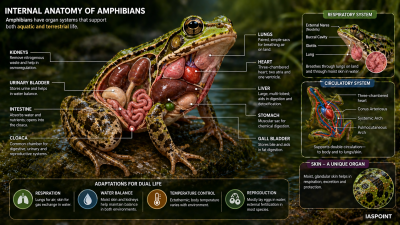
The internal anatomy of amphibians reflects their evolutionary transition from water to land. Their systems are designed to accommodate a dual lifestyle, featuring organs that handle both aquatic and terrestrial physiological demands.
1. Digestive System
Amphibians possess a complete digestive tract that begins at the mouth and terminates at the cloaca.
- Mouth and Tongue: Most amphibians have a “protrusible” tongue attached at the front of the lower jaw, allowing it to flip forward to capture prey.
- Teeth: Many possess vomerine teeth (on the roof of the mouth) and maxillary teeth (along the upper jaw), used primarily to grip prey rather than chew.
- Alimentary Canal: Consists of the esophagus, stomach (where chemical digestion begins), small intestine (nutrient absorption), and large intestine (water reabsorption).
- Accessory Organs: The liver (produces bile) and pancreas (produces digestive enzymes) are well-developed. The liver also serves as a primary site for glycogen storage.
2. Circulatory System
Amphibians exhibit a closed circulatory system with a “double circulation” pattern (pulmonary and systemic).
- Three-Chambered Heart: The heart consists of two atria and one ventricle.
- The Right Atrium receives deoxygenated blood from the body.
- The Left Atrium receives oxygenated blood from the lungs/skin.
- The Ventricle pumps the mixed blood to both the lungs and the rest of the body.
- Spiral Valve: Located in the conus arteriosus, it helps direct oxygenated blood toward the brain and deoxygenated blood toward the lungs, minimizing the inefficiency of blood mixing in the single ventricle.
- Three-Chambered Heart: The heart consists of two atria and one ventricle.
3. Respiratory System
Amphibians utilize a unique “tri-modal” respiratory strategy depending on their life stage and environment.
- Cutaneous Respiration: Gas exchange through the moist skin. This is the primary method during hibernation or while submerged.
- Buccopharyngeal Respiration: Exchange of gases across the moist lining of the mouth and pharynx.
- Pulmonary Respiration: Utilization of lungs. Amphibians use positive pressure breathing (buccal pumping), where they actively “swallow” air into the lungs because they lack a diaphragm.
- Gills: Present in all larval stages and retained in some “obligate aquatic” adult salamanders.
4. Excretory and Osmoregulatory System
Maintaining water balance is a major challenge for amphibians due to their permeable skin.
- Kidneys: A pair of mesonephric kidneys filter nitrogenous waste from the blood.
- Waste Product: * Larval (aquatic) stages typically excrete ammonia (ammonotelic).
- Adult (terrestrial) stages primarily excrete urea (ureotelic) to conserve water.
- Urinary Bladder: A large, thin-walled sac that stores urine. It can also act as a water reservoir during dry periods.
5. Nervous and Sensory Systems
- Brain Structure: The brain is divided into the forebrain (olfaction), midbrain (vision), and hindbrain (hearing and balance). The optic lobes (midbrain) are particularly prominent.
- Tympanum and Columella: The tympanum (external ear) vibrates and transmits sound through a single bone called the columella (homologous to the stapes in humans) to the inner ear.
- Jacobson’s Organ: A specialized chemoreceptive organ located in the nasal cavity used to detect pheromones and chemical signals.
6. Reproductive System
Amphibians are typically dioecious (separate sexes) with distinct internal reproductive organs.
- Males: Possess a pair of testes located near the kidneys. Sperm is transported through the vasa efferentia into the ureters (uromas).
- Females: Possess paired ovaries. Eggs pass through long, coiled oviducts where they are coated in a jelly-like substance before exiting through the cloaca.
- Fat Bodies: Yellow, finger-like projections attached to the gonads that store energy required for gamete production and hibernation.
Comparison of Larval vs. Adult Internal Anatomy
| Feature | Larval Stage (Tadpole) | Adult Stage (Frog/Salamander) |
| Respiration | Gills (External/Internal) | Lungs, Skin, and Mouth |
| Circulation | Two-chambered heart (Fish-like) | Three-chambered heart |
| Excretion | Ammonia (Ammonotelic) | Urea (Ureotelic) |
| Digestion | Long, coiled intestine (Herbivorous) | Shorter intestine (Carnivorous) |
UPSC Prelims Fact File
- Positive Pressure Ventilation: Unlike humans who create a vacuum (negative pressure) to breathe, amphibians must force air into their lungs.
- Erythrocytes: Amphibian Red Blood Cells (RBCs) are nucleated and oval-shaped, unlike the non-nucleated RBCs of mammals.
- Hibernation and Aestivation: During these periods of dormancy, the metabolic rate drops significantly, and the animal relies almost entirely on cutaneous respiration and stored fat bodies.