

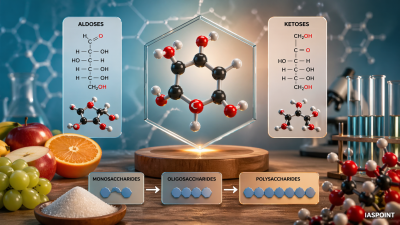
Monosaccharides, also known as simple sugars, are the most basic units of carbohydrates. They cannot be further hydrolyzed into simpler sugar molecules. In the biochemical hierarchy, they serve as the monomers for oligosaccharides and polysaccharides. Chemically, they are either polyhydroxy aldehydes (aldoses) or polyhydroxy ketones (ketoses).
Classification Based on Carbon Atoms
Monosaccharides are primarily categorized by the number of carbon atoms present in their backbone. In the UPSC context, understanding these prefixes is essential for identifying metabolic intermediates.
| Number of Carbons | Category | Examples | Biological Role |
| 3 Carbons | Trioses | Glyceraldehyde, Dihydroxyacetone | Intermediates in Glycolysis and Photosynthesis. |
| 4 Carbons | Tetroses | Erythrose | Used in the biosynthetic pathways of amino acids. |
| 5 Carbons | Pentoses | Ribose, Deoxyribose | Structural components of RNA and DNA. |
| 6 Carbons | Hexoses | Glucose, Fructose, Galactose | Primary respiratory substrates for energy. |
| 7 Carbons | Heptoses | Sedoheptulose | Intermediate in the Calvin Cycle. |
Structural Characteristics and Isomerism
Monosaccharides exhibit various forms of isomerism, which dictates their chemical behavior and how enzymes recognize them.
Aldoses vs. Ketoses
- Aldoses: Contain an aldehyde group (-CHO) at the end of the carbon chain. Examples: Glucose, Ribose, Galactose.
- Ketoses: Contain a ketone group (>C = O) usually at the second carbon. Examples: Fructose, Ribulose.
Open-chain and Ring Structures
In aqueous solutions, pentoses and hexoses usually exist in cyclic (ring) forms rather than straight chains.
- Pyranose: A six-membered ring structure (e.g., Glucopyranose).
- Furanose: A five-membered ring structure (e.g., Fructofuranose).
Key Monosaccharides and Their Significance
Glucose (Grape Sugar / Blood Sugar)
- It is an aldohexose and the most common monosaccharide.
- It is the primary product of photosynthesis and the fundamental source of energy for cellular respiration.
- It is a reducing sugar as it has a free aldehyde group.
Fructose (Fruit Sugar)
- It is a ketohexose and is the sweetest of all naturally occurring sugars.
- It is found abundantly in honey and fruits.
- In the human body, it is primarily metabolized in the liver.
Galactose
- An aldohexose that is a constituent of the disaccharide lactose (milk sugar).
- It is rarely found free in nature and is usually part of larger molecules like glycolipids and glycoproteins.
Ribose and Deoxyribose
- Ribose: A pentose sugar found in the backbone of RNA and ATP.
- Deoxyribose: Derived from ribose by the loss of one oxygen atom at the C-2 position; it forms the backbone of DNA.
Chemical Properties and Tests
- Reducing Property: All monosaccharides are reducing sugars. They possess a free or potentially free aldehyde or ketone group that can reduce cupric ions (Cu2+) to cuprous ions (Cu^+).
- Benedict’s and Fehling’s Test: Monosaccharides give a positive result (brick-red precipitate) with these reagents, which is a standard method for detecting glucose in urine (clinical significance for Diabetes Mellitus).
- Optical Activity: Most monosaccharides are optically active, meaning they can rotate plane-polarized light. Naturally occurring glucose is typically Dextrorotatory (d-glucose or +), while fructose is Levorotatory (l-fructose or -).
Fact File for UPSC Prelims
- Invert Sugar: A mixture of glucose and fructose obtained by the hydrolysis of sucrose. It is “inverted” because the optical rotation changes from dextro to levo.
- Brain Sugar: Galactose is often referred to as brain sugar because it is a vital component of glycolipids in the brain and nervous system.
- Sweetness Index: If Sucrose is rated at 100, Fructose is approximately 170, while Glucose is about 74.
- Epimers: Monosaccharides that differ in configuration around only one specific carbon atom. For example, Glucose and Galactose are epimers at the C-4 position.