

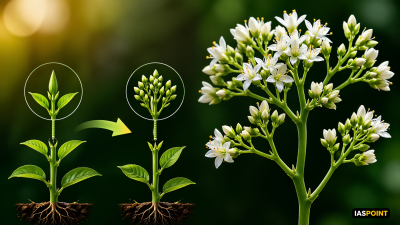
Inflorescence is defined as the arrangement and distribution of flowers on the floral axis, known as the peduncle. In plant morphology, the transition from a vegetative shoot apex to a reproductive shoot apex determines the pattern of inflorescence.
Major Types of Inflorescence
Inflorescences are primarily categorized based on whether the apex continues to grow or terminates in a flower.
Racemose Inflorescence (Indeterminate Type)
In this type, the main axis continues to grow indefinitely and does not terminate in a flower. The flowers are borne laterally in an acropetal succession (older flowers at the base, younger ones at the tip).
- Simple Raceme: Flowers with stalks (pedicels) arranged on an unbranched axis. Example: Mustard, Radish.
- Spike: Sessile flowers (without stalks) arranged on a long axis. Example: Achyranthes.
- Catkin: A pendulous spike with unisexual flowers. Example: Mulberry, Oak.
- Spadix: A spike with a fleshy axis enclosed by a large, often brightly colored bract called a spathe. Example: Maize, Colocasia, Palm.
- Corymb: The main axis is short; lower flowers have longer pedicels than upper ones so that all flowers reach the same level. Example: Candytuft (Iberis).
- Umbel: Flowers arise from a single point, resembling an umbrella. Example: Centella (Brahmi).
- Capitulum (Head): The receptacle is flattened, bearing numerous sessile flowers called florets (Ray and Disc florets). This is the most advanced inflorescence. Example: Sunflower, Marigold.
Cymose Inflorescence (Determinate Type)
In this type, the main axis terminates in a flower, limiting further growth. Flowers are arranged in a basipetal succession (older flowers at the top, younger ones at the base).
- Monochasial Cyme: A single lateral branch arises below the terminal flower. Example: Solanum.
- Dichasial Cyme: Two lateral branches arise below the terminal flower. Example: Jasmine, Teak.
- Polychasial Cyme: Multiple lateral branches arise at the same node. Example: Calotropis.
Specialized Inflorescence Types
Certain plants exhibit complex arrangements that do not strictly fit the standard Racemose or Cymose definitions.
- Cyathium: Characterized by a cup-shaped involucre containing a single female flower surrounded by multiple male flowers. Example: Euphorbia pulcherrima.
- Hypanthodium: The receptacle becomes fleshy and forms a hollow cavity with an apical opening (ostiole). Flowers are borne on the inner wall. Example: Ficus (Fig, Peepal, Banyan).
- Verticillaster: A cluster of sessile flowers appearing as a false whorl at the nodes. Example: Ocimum sanctum (Tulsi).
Comparative Summary of Racemose vs. Cymose
| Feature | Racemose Inflorescence | Cymose Inflorescence |
| Growth of Axis | Indeterminate (Unlimited) | Determinate (Limited) |
| Terminal Flower | Absent | Present |
| Arrangement | Acropetal (Oldest at base) | Basipetal (Oldest at apex) |
| Opening of Flowers | Centripetal (Outer to inner) | Centrifugal (Inner to outer) |
| Examples | Mustard, Wheat, Sunflower | Jasmine, Bougainvillea, Solanum |
Ecological and Biological Importance
Pollination Efficiency
Inflorescences increase the visibility of flowers to pollinators. Small flowers, which might be ignored individually, become conspicuous when grouped (e.g., Sunflower). The arrangement also facilitates different modes of pollination:
- Anemophily (Wind): Spikes and catkins (e.g., Grasses) are often wind-pollinated.
- Entomophily (Insects): Brightly colored bracts in spadix or cyathium attract specific insects.
Seed Dispersal and Survival
The clustering of flowers ensures that even if some flowers fail to fertilize, others in the group may succeed, maintaining the reproductive rate. The synchronous maturation in some types helps in massive seed production.
Fact Sheet for UPSC Prelims
- Largest Inflorescence: Amorphophallus titanum (Titan Arum) and Puya raimondii.
- The “Flower” of Sunflower: It is technically an inflorescence (Capitulum), not a single flower.
- Edible Inflorescence: Broccoli and Cauliflower are immature inflorescences.
- Bracts: These are leaf-like structures at the base of the inflorescence. In Bougainvillea, the brightly colored parts are bracts, not petals.
- Syconus Fruit: The fruit developed from a Hypanthodium inflorescence (e.g., Fig) is called a Syconus.
Taxonomy and Classification Utility
Inflorescence patterns are a primary “key” used in the Bentham and Hooker system of classification. For instance, the family Asteraceae (Compositae) is identified by the Capitulum, while Lamiaceae (Labiatae) is identified by the Verticillaster inflorescence. Understanding these patterns allows botanists and UPSC aspirants to categorize flora into specific families based on visual morphology.
Last Modified: April 24, 2026