

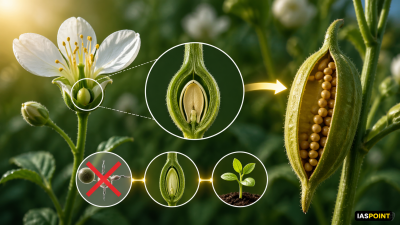
Apomixis is a form of asexual reproduction that mimics sexual reproduction by producing seeds without the process of fertilization. Derived from the Greek words apo (away from) and mixis (mixing), it refers to the absence of the union of male and female gametes.
Mechanisms of Apomixis
In most flowering plants, seeds are the result of pollination and fertilization. In apomictic plants, several pathways bypass these steps:
1. Recurrent Agamospermy
A diploid (2n) embryo sac is formed from either the nucellus cell or the diploid megaspore mother cell. Since the egg is already diploid, it develops directly into an embryo without fertilization.
2. Adventive Embryony (Sporophytic Apomixis)
Embryos develop directly from diploid sporophytic cells of the ovule, such as the nucellus or integuments. These cells intrude into the embryo sac and function as embryos.
- Examples: Citrus species, Mango (Mangifera indica), and Opuntia.
3. Diplospory and Apospory
- Diplospory: The megaspore mother cell undergoes abnormal meiosis or no meiosis at all, resulting in a diploid embryo sac.
- Apospory: The embryo sac is formed directly from a nucellar cell, bypassing the megaspore stage entirely.
Relationship with Polyembryony
Apomixis often leads to Polyembryony, which is the occurrence of more than one embryo in a single seed.
- In Citrus, besides the zygotic embryo (formed sexually), several nucellar cells develop into apomictic embryos.
- Result: When such a seed germinates, it produces multiple seedlings, where the apomictic ones are genetically identical to the parent plant (clones).
Evolutionary and Agricultural Significance
Impact on Hybrid Seed Industry
This is the most “application-based” aspect of apomixis relevant to UPSC GS Paper III (Science & Tech) and Prelims.
- The Problem: Hybrid seeds provide high yields, but farmers must buy them every year because the desirable “hybrid characters” segregate (separate) in the next generation due to sexual recombination.
- The Solution: If hybrids are made into apomicts, there is no segregation of characters. Farmers can keep the seeds from their harvest and grow the same high-quality hybrid crop year after year.
Genetic Stability
- Apomixis ensures the preservation of a specific genotype (clone) over generations.
- It allows for the rapid multiplication of superior varieties in environments where pollinators are scarce.
Comparative Summary: Sexual vs. Apomictic Reproduction
| Feature | Sexual Reproduction | Apomixis |
| Meiosis | Occurs (Reduces chromosome number) | Usually bypassed or abnormal |
| Fertilization | Essential (Syngamy) | Absent |
| Offspring | Genetically Diverse | Genetically Identical (Clones) |
| Seed Formation | Present | Present |
| Mimicry | N/A | Mimics sexual reproduction |
UPSC Prelims Trivia: Fact Check
- Major Families: Apomixis is most commonly observed in the families Asteraceae (Sunflower family) and Poaceae (Grasses).
- Parthenogenesis vs. Apomixis: While both involve reproduction without fertilization, Parthenogenesis specifically refers to the development of an unfertilized egg into an individual, whereas Apomixis is the broader term for seed production without fertilization in plants.
- Parthenocarpy vs. Apomixis: * Parthenocarpy: Production of fruit without fertilization (results in seedless fruits like Banana).
- Apomixis: Production of seeds without fertilization.
Research and Biotechnology
Active research is being conducted globally to identify “apomictic genes.” The goal is to transfer these genes into crop plants like wheat, rice, and maize to revolutionize the cost-efficiency of hybrid farming for small-scale farmers in developing nations.
Last Modified: April 24, 2026