

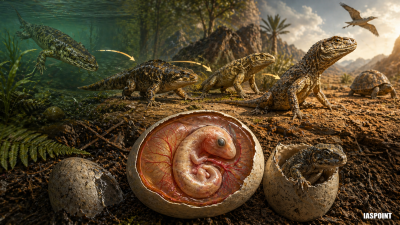
Reptiles belong to the class Reptilia, representing the first group of vertebrates to become fully adapted to life on land. Evolutionarily, they bridge the gap between amphibians and birds/mammals. The transition from aquatic to terrestrial life was made possible by the development of the amniotic egg, which allows embryos to breathe and prevents desiccation without the need for a water medium.
Anatomical and Physiological Characteristics
Physical Structure and Integumentary System
Reptiles are characterized by a body covered in dry, cornified skin. Unlike amphibians, they lack mucous glands.
- Epidermal Scales: Their skin is covered in scales or scutes made of keratin, which provides protection and prevents water loss.
- Ecdysis: Many reptiles, particularly snakes and lizards, undergo “molting” or shedding of the skin to allow for growth and removal of parasites.
- Limbs: Most reptiles possess two pairs of limbs with five digits each (pentadactyl), though limbs are lost in snakes and certain lizard species.
Respiratory and Circulatory Systems
- Respiration: Reptiles breathe exclusively through lungs throughout their life cycle. Unlike amphibians, they do not utilize cutaneous respiration (breathing through skin).
- Heart Structure: Most reptiles possess a three-chambered heart (two atria and one partially divided ventricle).
- The Crocodilian Exception: Crocodilians are the only reptiles with a sophisticated four-chambered heart, a trait shared with birds and mammals.
- Poikilothermy: They are cold-blooded (ectothermic) animals, meaning they cannot regulate their internal body temperature and rely on external heat sources.
Sensory and Nervous Systems
- Tympanum: Reptiles lack an external ear opening; the tympanum represents the ear.
- Jacobson’s Organ: Highly developed in snakes and lizards, this olfactory sense organ (vomeronasal organ) allows them to “taste” chemical particles in the air using their tongues.
Reproductive Biology and Development
Reptiles are primarily dioecious (separate sexes) and exhibit internal fertilization.
- Oviparous Nature: Most reptiles lay eggs with a leathery or calcareous shell.
- Amniotic Egg: These eggs contain specialized membranes (amnion, chorion, yolk sac, and allantois) that protect the embryo.
- Development: Development is direct, meaning there is no larval stage (unlike the tadpole stage in amphibians).
Classification of Living Reptiles
| Order | Common Name | Key Representative Species | Notable Feature |
| Testudines | Turtles and Tortoises | Chelone (Turtle), Testudo (Tortoise) | Possess a bony or cartilaginous shell (Carapace/Plastron). |
| Squamata | Lizards and Snakes | Hemidactylus (Wall lizard), Naja (Cobra) | Largest order; characterized by movable quadrate bones. |
| Crocodilia | Crocodiles and Alligators | Crocodylus (Crocodile), Gavialis (Gharial) | Four-chambered heart; semi-aquatic predators. |
| Rhynchocephalia | Tuatara | Sphenodon | Often called “living fossils”; found only in New Zealand. |
Major Indian Reptile Species of Conservation Importance
The “Big Four” Venomous Snakes of India
These species are responsible for the majority of snakebite fatalities in the Indian subcontinent:
- Spectacled Cobra (Naja naja): Recognized by the hood mark.
- Common Krait (Bungarus caeruleus): Primarily nocturnal and highly neurotoxic.
- Russell’s Viper (Daboia russelii): Known for a loud hiss and hemotoxic venom.
- Saw-scaled Viper (Echis carinatus): The smallest of the big four but highly aggressive.
Crocodilian Species in India
- Gharial (Gavialis gangeticus): Critically Endangered; characterized by a long, thin snout. Found primarily in the Chambal River.
- Mugger Crocodile (Crocodylus palustris): A freshwater crocodile found throughout the Indian subcontinent.
- Saltwater Crocodile (Crocodylus porosus): The largest living reptile; found in Bhitarkanika (Odisha) and the Andaman & Nicobar Islands.
Biological Trivia for Prelims
Distinction between Turtles and Tortoises
- Turtles: Primarily aquatic (marine or freshwater) with webbed feet or flippers.
- Tortoises: Exclusively land-dwelling with sturdy, stumpy feet similar to elephant feet.
Thermoregulation Mechanisms
Because reptiles are poikilotherms, they exhibit behavioral thermoregulation. They bask in the sun to increase body temperature (heliothermy) and retreat to shade or burrows to cool down.
Parthenogenesis
Some reptilian species, such as certain Whiptail lizards, can reproduce through parthenogenesis—a form of asexual reproduction where embryos grow and develop without fertilization by a male.
Conservation Status and Legal Framework in India
In India, reptiles are protected under the Wildlife (Protection) Act, 1972.
- Schedule I: Includes high-priority species like the Gharial, Golden Gecko, and Python.
- CITES: Most international trade in reptile skins (crocodiles, snakes) is strictly regulated under CITES Appendices to prevent over-exploitation.