

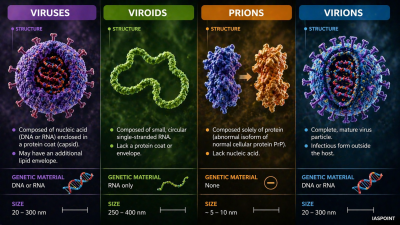
In the study of microbiology for UPSC, it is essential to distinguish between viruses and other infectious particles that lack the standard viral structure (protein coat + nucleic acid). Viroids, Prions, and Virions represent different states or types of infectious entities.
1. Viroids: The Smallest Pathogens
Viroids are infectious agents that are even smaller than viruses. They were first discovered by T.O. Diener in 1971.
Structural Characteristics
- Composition: They consist solely of a short strand of circular, single-stranded RNA (ssRNA).
- Lack of Capsid: Unlike viruses, they completely lack a protein coat (capsid).
- Molecular Weight: The RNA is of very low molecular weight.
Key Facts and Examples
- Host Range: They primarily infect higher plants; no viroid diseases in humans are currently confirmed, though they are biologically similar to certain human RNA agents.
- Mechanism: They do not code for any proteins but hijack the host cell’s RNA polymerase to replicate.
- Example Disease: Potato Spindle Tuber Disease (PSTVd), which causes stunted growth and malformation in potato plants.
2. Prions: Proteinaceous Infectious Particles
Prions (Proteinaceous Infectious particles) are unique because they contain no nucleic acid (neither DNA nor RNA). They are composed entirely of abnormally folded proteins.
Pathogenesis
- Mechanism: Prions induce normal proteins in the host’s brain to fold into the same abnormal shape. This leads to a chain reaction that destroys nerve cells.
- Resilience: They are remarkably resistant to standard sterilization methods like heat, radiation, and disinfectants that typically kill bacteria and viruses.
Major Prion Diseases
| Disease Name | Affected Host | Symptoms |
| Bovine Spongiform Encephalopathy (BSE) | Cattle | Commonly known as “Mad Cow Disease.” |
| Creutzfeldt-Jakob Disease (CJD) | Humans | Rapidly progressive dementia and neurological failure. |
| Kuru | Humans | Neurological disease associated with ritualistic cannibalism (historical). |
| Scrapie | Sheep/Goats | Degenerative disease of the nervous system. |
3. Virions: The Extracellular State
The term Virion does not refer to a different “type” of microbe like a prion or viroid, but rather a specific physical state of a virus.
Functional Definition
- Definition: A virion is the complete, fully functional, and infectious virus particle as it exists outside the host cell.
- Structure: It consists of the nucleic acid core (DNA/RNA) and the outer protein shell (capsid), plus an envelope if the virus is enveloped.
- Role: The virion’s primary function is to protect the viral genome and transport it from one host cell to another. Once the virion enters a host cell and “uncoats,” it is simply referred to as a virus.
Comparative Summary Table
| Feature | Virus | Viroid | Prion |
| Composition | Nucleic Acid + Protein Coat | Naked RNA only | Protein only |
| Nucleic Acid | DNA or RNA | RNA only | None |
| Protein | Present (Capsid) | Absent | Present |
| Size | Small | Very Small | Smallest |
| Primary Host | Bacteria, Plants, Animals | Plants | Animals (Nervous system) |
Quick Facts for UPSC Prelims
- T.O. Diener: Credited with the discovery of Viroids.
- Stanley Prusiner: Awarded the Nobel Prize for his discovery of Prions.
- Inert Nature: All three entities (Viruses, Viroids, Prions) are inert outside a living host, making them “obligate intracellular parasites” or infectious agents.
- Self-Purification: While bacteriophages (viruses) are found in the Ganga, prions and viroids are not involved in water purification; they are purely pathogenic.