

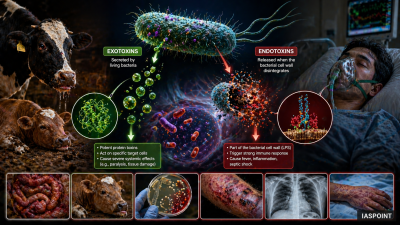
Bacterial diseases in animals, including livestock and humans, are often more severe than viral infections because bacteria can produce potent toxins. These toxins are classified into Exotoxins (secreted by living bacteria) and Endotoxins (released when the bacterial cell wall disintegrates).
Major Bacterial Diseases in Livestock and Wildlife
Bacterial infections in cattle and poultry have significant economic implications for India’s agrarian economy.
| Disease Name | Causal Organism | Primary Host | Key Symptoms/Facts |
| Anthrax | Bacillus anthracis | Cattle, Sheep, Goats | Sudden death, bleeding from orifices; highly zoonotic. |
| Brucellosis | Brucella abortus | Cattle, Buffalo | Causes “Contagious Abortion” and infertility. |
| Hemorrhagic Septicemia | Pasteurella multocida | Buffalo, Cattle | Swelling of the throat, respiratory distress (Galsua). |
| Black Quarter | Clostridium chauvoei | Cattle, Sheep | Swelling in hindquarters, lameness, and high fever. |
| Mastitis | Staphylococcus aureus | Milching animals | Inflammation of mammary glands; reduces milk quality. |
| Pullorum Disease | Salmonella pullorum | Poultry (Chickens) | High mortality in chicks; white diarrhea. |
Major Bacterial Diseases in Humans (Zoonotic and Others)
Many animal-borne bacterial diseases are Zoonotic, meaning they can jump from animals to humans.
Anthrax (Splenic Fever)
- Pathogen: Bacillus anthracis (spore-forming).
- Transmission: Contact with infected animal hides, wool, or inhalation of spores.
- Trivia: It is famously known as Wool Sorter’s Disease and was the first bacterium used by Robert Koch to prove the “Germ Theory of Disease.”
Tuberculosis (TB)
- Pathogen: Mycobacterium tuberculosis (Humans) and Mycobacterium bovis (Cattle).
- Target: Primarily the lungs, but can affect bones and intestines.
- Diagnosis: The Mantoux test is used for screening.
Tetanus (Lockjaw)
- Pathogen: Clostridium tetani.
- Mechanism: Produces a neurotoxin (Tetanospasmin) that causes painful muscle contractions, usually starting in the jaw.
- Source: Spores are commonly found in soil and animal dung.
Comparative Summary of Human Bacterial Pathogens
| Disease | Bacterium | Mode of Transmission |
| Cholera | Vibrio cholerae | Contaminated water/food |
| Typhoid | Salmonella typhi | Contaminated food (fecal-oral) |
| Plague | Yersinia pestis | Flea bites (Vector: Rat flea) |
| Leprosy | Mycobacterium leprae | Prolonged close contact |
| Pneumonia | Streptococcus pneumoniae | Droplet infection |
Mechanisms of Transmission in Animals
- Direct Contact: Through skin abrasions or mucous membranes.
- Ingestion: Consuming contaminated fodder, water, or infected milk (e.g., Brucellosis).
- Inhalation: Airborne droplets carrying respiratory pathogens like Mycobacterium.
- Vectors: Insects like fleas (Plague) or ticks (Lyme disease) that carry bacteria from one host to another.
Prevention and Treatment
- Antibiotics: Penicillin, Streptomycin, and Tetracycline are the frontline treatments.
- Vaccination: Vaccines like BCG (for TB) and the Anthrax vaccine are crucial for prevention.
- One Health Approach: A collaborative effort between veterinary and human medicine to manage zoonotic bacterial outbreaks, a concept frequently highlighted in recent UPSC papers.
Fact-Sheet for UPSC Prelims
- Endospores: Bacteria like Bacillus and Clostridium form spores that can survive in the soil for decades, making diseases like Anthrax and Tetanus hard to eradicate.
- Obligate Parasites: Mycobacterium leprae (Leprosy) is one of the few bacteria that cannot be cultured on artificial media; it is grown on the footpads of armadillos for research.
- First Antibiotic: Penicillin, derived from the fungus Penicillium notatum, was the first “wonder drug” used to treat bacterial infections in animals and humans.
- The Plague: Known as the “Black Death,” it is caused by Yersinia pestis and is a classic example of a sylvatic (wildlife) cycle jumping to humans via rodents.