

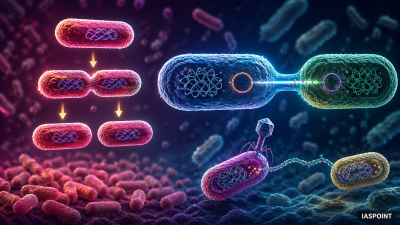
Bacterial reproduction is characterized by its rapidity and simplicity, allowing populations to double in size within minutes under optimal conditions. While bacteria primarily reproduce asexually, they also exhibit “parasexuality”—mechanisms for genetic recombination that ensure evolutionary adaptability without the formation of gametes.
Asexual Reproduction
Asexual methods are the primary means of multiplication, resulting in genetically identical clones of the parent cell.
Binary Fission
This is the most common method of reproduction in bacteria under favorable environmental conditions.
- Process: The circular DNA molecule replicates and the two copies move to opposite poles. The cell membrane then invaginates, and a new cell wall (septum) is deposited, dividing the parent cell into two identical daughter cells.
- Speed: Under ideal conditions, E. coli can undergo binary fission every 20 minutes.
Endospore Formation
This is not a method of multiplication but a mechanism for survival under unfavorable conditions (extreme heat, radiation, or desiccation).
- Structure: A highly resistant, thick-walled dormant structure formed within the bacterial cell.
- Composition: Contains a core of DNA, ribosomes, and a high concentration of dipicolinic acid and calcium ions, which provide heat resistance.
- Germination: When conditions become favorable again, the endospore germinates to produce a single vegetative cell.
- Examples: Bacillus anthracis and Clostridium tetani.
Budding and Fragmentation
- Budding: A small protuberance (bud) develops from the parent cell, enlarges, and eventually separates (e.g., Hyphomicrobium).
- Fragmentation: Filamentous bacteria (like Actinomycetes) break into small fragments, each of which grows into a new colony.
Genetic Recombination (Parasexuality)
In bacteria, true sexual reproduction involving meiosis and fusion of gametes is absent. Instead, they achieve genetic variability through the transfer of DNA fragments.
Transformation
- Mechanism: The uptake of “naked” foreign DNA from the surrounding environment by a bacterial cell.
- Fact: This was first demonstrated by Frederick Griffith in 1928 using Streptococcus pneumoniae (Griffith’s Experiment).
- Competence: Only “competent” cells can take up DNA from the environment.
Transduction
- Mechanism: The transfer of bacterial DNA from one cell to another via a Bacteriophage (a virus that infects bacteria).
- Discovery: Discovered by Zinder and Lederberg in Salmonella.
- Types: * Generalized Transduction: Any piece of bacterial DNA is packaged into a phage.
- Specialized Transduction: Only specific bacterial genes are transferred.
Conjugation
- Mechanism: The direct transfer of DNA between two bacterial cells that are temporarily joined.
- Process: A donor cell (F+ or male) carries a fertility factor (F-plasmid) and forms a Sex Pilus to connect with a recipient cell (F- or female). The plasmid DNA is then replicated and transferred.
- Discovery: Discovered by Lederberg and Tatum in E. coli.
Comparison of Genetic Recombination Methods
| Method | Vector/Agent Involved | Source of DNA | Key Scientist |
| Transformation | None (Naked DNA) | Environment | Frederick Griffith |
| Transduction | Bacteriophage (Virus) | Donor Bacteria | Zinder & Lederberg |
| Conjugation | Sex Pilus (F-Plasmid) | Donor Bacteria | Lederberg & Tatum |
Fact-Sheet for UPSC Prelims
- Generation Time: The time required for a bacterial population to double; it varies by species and environment.
- Plasmids: Small, circular, self-replicating extra-chromosomal DNA often involved in conjugation and carrying antibiotic resistance genes (R-plasmids).
- Horizontal Gene Transfer (HGT): The collective term for transformation, transduction, and conjugation. HGT is the primary reason for the rapid spread of Multi-Drug Resistance (MDR) in hospitals.
- Nostoc and Anabaena: These cyanobacteria reproduce through fragmentation and the formation of Akinetes (thick-walled resting spores).