

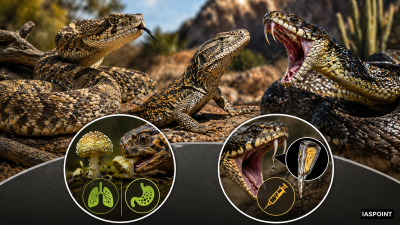
In biological terms, reptiles are generally “venomous” rather than “poisonous.” Poison is inhaled or ingested, whereas venom is actively injected through specialized apparatus like fangs.
1. The “Big Four” Venomous Snakes of India
The majority of snakebite fatalities in India are attributed to four specific species. Understanding their features is essential for field identification.
- Spectacled Cobra (Naja naja): Identified by a distinct “spectacle” mark on the dorsal side of the hood. It possesses neurotoxic venom that affects the nervous system.
- Common Krait (Bungarus caeruleus): Nocturnal in habit. It has a glossy black/blue body with thin white crossbands. Its venom is extremely neurotoxic and often leads to respiratory failure.
- Russell’s Viper (Daboia russelii): Recognized by three rows of dark brown ovals or “chains” along the body. It produces a loud, pressure-cooker-like hiss and has hemotoxic venom (affects blood clotting).
- Saw-scaled Viper (Echis carinatus): Small but highly aggressive. It makes a “sawing” sound by rubbing its scales together. It also possesses hemotoxic venom.
2. Key Morphological Differences: Venomous vs. Non-Venomous Snakes
While there are exceptions, certain morphological traits help in broad categorization.
| Feature | Venomous Snakes | Non-Venomous Snakes |
| Head Shape | Often triangular or diamond-shaped due to venom glands. | Usually rounded or oval. |
| Pupils | Elliptical or “cat-like” (vipers). | Usually round (exceptions like Cobras). |
| Fangs | Present (fixed or retractable). | Absent; have uniform small teeth. |
| Tail | Often tapers abruptly. | Usually tapers gradually to a point. |
| Ventral Scales | Large scales covering the entire width of the belly. | Smaller scales that do not cover the full width (in primitive species). |
3. Venom Apparatus and Delivery Mechanism
The venom system is a modified salivary apparatus.
- Venom Glands: Modified parotid glands located behind the eyes.
- Fangs: Specialized hollow or grooved teeth.
- Solenoglyphous: Long, foldable fangs (Vipers).
- Proteroglyphous: Short, fixed fangs at the front of the mouth (Cobras, Kraits).
- Opisthoglyphous: Rear-fanged (Vine snakes; mildly venomous).
- Venom Types:
- Neurotoxic: Attacks the central nervous system (Cobra, Krait).
- Hemotoxic: Destroys red blood cells and disrupts clotting (Vipers).
- Cytotoxic: Causes localized tissue damage and necrosis.
4. Notable Non-Venomous Snakes of India
These species are often killed due to mistaken identity, despite being ecologically beneficial.
- Indian Rock Python (Python molurus): A massive constrictor. It kills prey by squeezing rather than biting. Listed under Schedule I of the Wildlife Protection Act.
- Rat Snake (Ptyas mucosa): Commonly called “Dhaman.” It is very fast and often confused with the Cobra, though it lacks a hood and has a more slender head.
- Checkered Keelback: Found near water bodies. It is aggressive and bites readily but carries no venom.
- Common Sand Boa: A blunt-tailed snake often involved in illegal trade due to superstitions about “two heads” or medicinal properties.
5. Venomous Lizards: A Global Perspective
The vast majority of the world’s 6,000+ lizard species are non-venomous.
- Gila Monster (Heloderma suspectum): Found in the Southwestern US and Mexico. One of the few truly venomous lizards.
- Mexican Beaded Lizard: Closely related to the Gila Monster.
- Komodo Dragon: Once thought to be non-venomous, recent research shows they possess complex venom glands that induce shock and prevent blood clotting in prey.
- Indian Context: All lizards found in Indian households (like the Common Wall Gecko) are non-venomous. The common myth that geckos poison food is factually incorrect.
6. Mimicry: The Evolutionary Deception
Certain non-venomous reptiles evolve to look like venomous ones to deter predators.
- Batesian Mimicry: The Common Wolf Snake (non-venomous) looks remarkably similar to the Common Krait (highly venomous).
- Identification Tip: Kraits have hexagonal scales along the spine (vertebral scales), whereas Wolf Snakes do not.
7. Medical and Legal Facts for UPSC
- Antivenom (ASV): In India, polyvalent antivenom is used, which is effective against all of the “Big Four.”
- Wildlife Protection Act (1972): All snakes are protected under various schedules. Killing or capturing them without a permit is a punishable offense.
- King Cobra Fact: While highly venomous, the King Cobra is shy and generally avoids human contact. It is the only snake that builds a nest.