

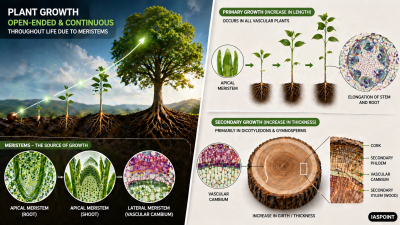
Growth in plants is unique because it is “open-ended,” occurring throughout the life of the organism due to the presence of meristems. While all vascular plants undergo primary growth to increase in length, secondary growth is a specialized process primarily seen in dicotyledons and gymnosperms to increase thickness.
1. Primary Growth: Vertical Development
Primary growth is the result of cell division in the apical meristems located at the tips of roots and shoots. This process is responsible for the plant’s elongation and the formation of the primary plant body.
- Origin: Derived from Apical Meristems (Shoot Apical Meristem and Root Apical Meristem) and Intercalary Meristems.
- Result: Increases the height of the plant and the length of the roots.
- Tissues Involved: Formation of primary xylem, primary phloem, epidermis, and ground tissues (parenchyma, collenchyma).
- Occurrence: Occurs in all vascular plants, including both monocots and dicots.
2. Secondary Growth: Lateral Development
Secondary growth follows primary growth and results in an increase in the thickness or girth of the plant. This is particularly vital for trees and woody shrubs to provide structural support for their height.
- Origin: Derived from Lateral Meristems, specifically the Vascular Cambium and Cork Cambium (Phellogen).
- Result: Increases the diameter of the stem and root; leads to the formation of wood and bark.
- Tissues Involved: Formation of secondary xylem (wood), secondary phloem, and periderm (bark).
- Occurrence: Primarily occurs in dicots and gymnosperms. It is generally absent in monocots due to the lack of lateral meristems.
Comparison of Primary and Secondary Growth
| Feature | Primary Growth | Secondary Growth |
| Meristem Involved | Apical and Intercalary Meristems. | Lateral Meristems (Vascular and Cork Cambium). |
| Direction of Growth | Longitudinal (Length/Height). | Radial (Thickness/Girth). |
| Time of Occurrence | Early in the life of the plant. | Later, after the primary tissues have matured. |
| Components Formed | Primary Xylem, Primary Phloem, Pith, Cortex, Epidermis. | Secondary Xylem (Wood), Secondary Phloem, Bark, Cork. |
| Plant Groups | All vascular plants (Monocots and Dicots). | Mainly Dicots and Gymnosperms. |
3. Key Mechanisms of Secondary Growth
The Vascular Cambium
The vascular cambium is a ring of meristematic tissue that develops between the primary xylem and primary phloem.
- Cells divide to produce Secondary Xylem toward the interior (forming wood).
- Cells divide to produce Secondary Phloem toward the exterior.
- Because more secondary xylem is produced than secondary phloem, the bulk of a tree trunk is actually secondary xylem.
The Cork Cambium (Phellogen)
As the stem increases in girth, the outer epidermis breaks down. The cork cambium develops in the cortex to replace it.
- It produces Cork (Phellem) on the outside, which is impregnated with Suberin (a waterproof waxy substance).
- It produces Secondary Cortex (Phelloderm) on the inside.
- Together, the Phellogen, Phellem, and Phelloderm are known as the Periderm.
4. Annual Rings and Dendrochronology
In temperate regions, the activity of the vascular cambium varies with the seasons, leading to the formation of Annual Rings.
- Spring Wood (Early Wood): Produced in spring; xylem vessels have wider lumens to transport more water.
- Autumn Wood (Late Wood): Produced in winter/autumn; xylem vessels are narrow and more densely packed.
- Dendrochronology: The science of counting and analyzing these annual rings to determine the age of a tree and past climatic conditions.
UPSC Prelims Facts and Trivia
- Heartwood vs. Sapwood: Heartwood is the central, dark, non-functional secondary xylem (clogged with resins/tannins), while Sapwood is the peripheral, functional part involved in water transport.
- Bark: In botanical terms, ‘Bark’ refers to all tissues outside the vascular cambium, including secondary phloem and periderm.
- Lenticels: These are lens-shaped openings in the bark of woody stems that allow for gas exchange, bypassing the waterproof cork layer.
- Stele: The central part of the root or stem containing the tissues derived from the procambium (xylem, phloem, and sometimes pith).
- Monocot Exception: While most monocots lack secondary growth, some like Dracaena and Yucca show “anomalous secondary growth.”