

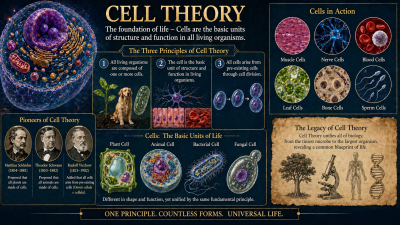
Cell Theory is a fundamental principle in biology that describes the properties of cells, which serve as the basic units of structure in all living organisms.
Historical Development of Cell Theory
The formulation of Cell Theory was not a single event but a culmination of discoveries by several scientists over nearly two centuries.
- Robert Hooke (1665): Observed “cells” in a thin slice of cork using a primitive microscope. He coined the term based on the Latin cella (small room).
- Anton van Leeuwenhoek (1674): First to observe living cells (bacteria and protozoa) in pond water using improved lenses.
- Matthias Schleiden (1838): A German botanist who concluded that all plant parts are composed of cells.
- Theodor Schwann (1839): A German zoologist who concluded that all animal tissues are composed of cells. He also postulated that cells are the basic unit of life.
- Rudolf Virchow (1855): Added the final crucial tenet: Omnis cellula e cellula, meaning “All cells arise from pre-existing cells.”
The Three Core Tenets of Classical Cell Theory
- All living organisms are composed of one or more cells.
- The cell is the basic structural and functional unit of life.
- All cells arise from pre-existing cells through the process of cell division.
Modern Cell Theory (Post-Classical Additions)
As microscopy and molecular biology advanced, the classical theory was expanded to include the following facts:
- Energy Flow: Metabolism and biochemistry (energy flow) occur within cells.
- Genetic Material: Cells contain DNA which is passed from cell to cell during cell division.
- Chemical Composition: All cells are basically the same in chemical composition in organisms of similar species.
Exceptions to Cell Theory
For the UPSC Prelims, it is vital to note that Cell Theory is not universal. Certain entities do not fit the criteria:
- Viruses: They lack a cellular machinery and are metabolically inactive outside a host. They consist only of genetic material (DNA or RNA) encased in a protein coat (capsid).
- Viroids and Prions: Simpler than viruses, these infectious agents lack a cellular structure entirely.
- Coenocytic Organisms: Certain algae (e.g., Vaucheria) and fungi (e.g., Rhizopus) consist of a continuous mass of protoplasm with many nuclei, lacking internal cell boundaries (septal walls).
- Mature RBCs and Sieve Tubes: Mature mammalian Red Blood Cells (RBCs) and plant sieve tube cells lack a nucleus, though they are considered living components of a cellular organism.
Categorization of Organisms Based on Cell Theory
| Category | Description | Examples |
| Unicellular | Single cell performs all life functions. | Amoeba, Bacteria, Paramecium. |
| Multicellular | Specialized cells organized into tissues/organs. | Humans, Mango trees, Insects. |
| Acellular | Lack typical cellular organization. | Viruses. |
Significance of Cell Theory in Modern Science
- Evolutionary Biology: The tenet that cells come from pre-existing cells supports the theory of common descent and the evolution of life from a single primordial cell.
- Medical Research: Understanding cellular processes is the basis for Stem Cell Therapy, Cancer research (uncontrolled cell division), and Tissue Engineering.
- Forensics: DNA analysis relies on the fact that every nucleated cell in an individual’s body contains the same genetic blueprint.
Facts and Trivia for UPSC
- Smallest Cell: Mycoplasma gallisepticum (a PPLO – Pleuropneumonia-like organism), measuring approximately 0.1 to 0.3 micrometers.
- Largest Isolated Single Cell: The egg of an Ostrich.
- Longest Cell in Humans: The Neuron (Nerve cell), which can reach lengths of over 1 meter.
- Protoplasm vs. Cytoplasm: Purkinje coined the term ‘Protoplasm’ in 1839 for the fluid substance of the cell. Protoplasm includes the cytoplasm and the nucleus.