

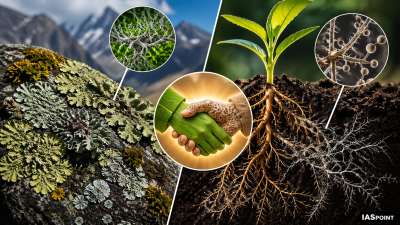
In the study of biological interactions for UPSC Prelims, symbiotic relationships represent a critical area of “Mutualism,” where both participating species derive benefit. Lichens and Mycorrhiza are the two most prominent examples of such associations involving fungi, playing vital roles in ecological succession and nutrient cycling.
Lichens: The Composite Organisms
Lichens are not single organisms but stable symbiotic associations between a fungus (Mycobiont) and a photosynthetic partner (Photobiont), which can be either green algae or cyanobacteria.
Structural Composition of Lichens
- Mycobiont (Fungal Partner): Typically belongs to Ascomycetes or Basidiomycetes. It provides the structural framework, protects the algae from environmental stress, and absorbs water and minerals from the substrate.
- Photobiont (Algal/Cyanobacterial Partner): Provides food through photosynthesis. If the partner is a cyanobacterium (e.g., Nostoc), it also performs nitrogen fixation.
- Symbiotic Nature: This relationship is often described as Helotism, a form of “master-slave” relationship where the fungus dominates but both survive together.
Morphological Classification
Lichens are categorized based on their growth forms, which is a significant indicator of ecological health:
- Crustose: Thin, crust-like layers closely adherent to rocks or bark (e.g., Graphis).
- Foliose: Leaf-like, lobed structures attached at specific points (e.g., Parmelia).
- Fruticose: Pendulous or upright branching structures, hair-like or shrubby (e.g., Usnea, Cladonia).
Ecological and Economic Significance
- Pioneer Species: Lichens are the first to colonize bare rocks in primary succession. They secrete organic acids (like oxalic acid) that weather rocks into soil.
- Bio-indicators: Lichens are extremely sensitive to air pollution, particularly Sulfur Dioxide (SO2). Their absence in an area indicates high pollution levels (“Lichen Deserts”).
- Litmus Paper: The pH indicator Litmus is extracted from the lichen Roccella tinctoria.
- Food and Fodder: Cladonia rangiferina (Reindeer moss) serves as food for animals in tundra regions. Lecanora esculenta is known as the “Manna” of the Bible.
Mycorrhiza: The Fungal-Root Association
Mycorrhiza (literally “fungus root”) is a mutualistic association between specialized fungi and the roots of higher plants. Over 90% of terrestrial plant families exhibit this symbiosis.
Types of Mycorrhiza
| Feature | Ectomycorrhiza | Endomycorrhiza (VAM) |
| Fungal Penetration | Hyphae do not penetrate the host cell walls. | Hyphae penetrate the cortical cell walls. |
| Structural Feature | Forms a “Hartig Net” and a fungal mantle/sheath. | Forms Arbuscules (branched) and Vesicles (storage). |
| Occurrence | Common in Forest trees (Pinus, Oak, Beech). | Common in Crop plants, Grasses, and Orchids. |
| Fungal Group | Mostly Basidiomycetes. | Mostly Glomeromycetes. |
Functional Benefits to the Ecosystem
- Nutrient Mobilization: The fungal hyphae extend far into the soil, increasing the surface area for the absorption of Phosphorus, Nitrogen, and micronutrients.
- Drought and Salt Tolerance: Mycorrhizal plants show higher resilience to environmental stressors and soil toxicity.
- Pathogen Protection: The fungal mantle provides a physical barrier and secretes antimicrobial substances that protect roots from soil-borne pathogens like Phytophthora.
- Obligate Symbiosis: Some plants, like Pinus, cannot germinate or establish without mycorrhizal association.
Comparative Summary for Prelims
| Aspect | Lichens | Mycorrhiza |
| Partners | Fungus + Algae/Cyanobacteria | Fungus + Roots of Higher Plants |
| Primary Benefit | Colonization of barren habitats | Nutrient (Phosphorus) uptake |
| Human Use | Pollution monitoring, dyes, medicine | Bio-fertilizers in agriculture |
| Unique Fact | Reproduce via Soredia and Isidia | Essential for Orchid seed germination |
Important Trivia for UPSC
- Dual Nature: The dual nature of lichens was first proposed by S. Schwendener in 1867.
- VAM (Vesicular Arbuscular Mycorrhiza): It is frequently used in sustainable agriculture as a bio-fertilizer to reduce dependency on chemical phosphatic fertilizers.
- Bio-mining: Lichens contribute to the biological weathering of rocks, a process essential for soil formation (Pedogenesis).
- Specific Examples: Amanita muscaria forms ectomycorrhiza with birch trees, while Glomus species are the most common VAM fungi used in farming.