

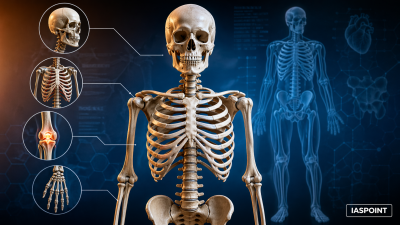
The human skeletal system is a specialized framework of 206 bones (in adults) that provides structural support, protects vital organs, facilitates movement, and serves as a reservoir for minerals.
Classification by Position: Axial vs. Appendicular
The skeleton is divided into two main groups based on their location along the body’s axis.
Axial Skeleton (80 Bones)
The axial skeleton forms the vertical axis of the body.
- Skull: Comprises 22 bones (8 cranial and 14 facial).
- Hyoid Bone: A U-shaped bone in the neck that supports the tongue; notably, it does not articulate with any other bone.
- Auditory Ossicles: Six tiny bones (Malleus, Incus, Stapes) in the middle ear. The Stapes is the smallest bone in the human body.
- Vertebral Column: Consists of 26 segmented bones (Cervical, Thoracic, Lumbar, Sacrum, and Coccyx).
- Thoracic Cage: Includes the Sternum (breastbone) and 12 pairs of Ribs.
Appendicular Skeleton (126 Bones)
This system allows for locomotion and manipulation of the environment.
- Pectoral Girdles: Consist of the Clavicle (collar bone) and Scapula (shoulder blade).
- Upper Limbs: Includes the Humerus, Radius, Ulna, Carpals, Metacarpals, and Phalanges.
- Pelvic Girdle: Formed by the hip bones (Coxal bones).
- Lower Limbs: Includes the Femur (thigh bone—longest and strongest bone), Tibia, Fibula, Patella (kneecap), Tarsals, Metatarsals, and Phalanges.
Morphological Classification of Bones
Bones are categorized by their shape, which dictates their mechanical function.
| Bone Type | Characteristics | Primary Examples |
| Long Bones | Longer than they are wide; act as levers. | Femur, Humerus, Tibia, Fibula. |
| Short Bones | Cube-shaped; provide stability and some movement. | Carpals (wrist), Tarsals (ankle). |
| Flat Bones | Thin, curved; provide extensive protection. | Sternum, Ribs, Cranial bones, Scapula. |
| Irregular Bones | Complex shapes that do not fit other categories. | Vertebrae, Sacrum, Mandible. |
| Sesamoid Bones | Small, round bones embedded in tendons. | Patella (Kneecap). |
Histological Composition: Compact and Spongy Bone
Bone tissue (Osseous tissue) is a dense connective tissue consisting of a collagen matrix mineralized with calcium phosphate.
Compact (Cortical) Bone
- Forms the hard outer layer of all bones.
- Functional unit is the Osteon (Haversian System).
- Provides protection and support, resisting the stresses of weight and movement.
Spongy (Cancellous) Bone
- Located in the interior of bones, especially at the ends of long bones.
- Composed of a lattice-like network called Trabeculae.
- Contains Red Bone Marrow, where Hematopoiesis (production of blood cells) occurs.
Cellular Components of Bone
Understanding the four types of bone cells is critical for questions regarding bone remodeling and metabolic diseases.
- Osteogenic Cells: Stem cells that divide to produce osteoblasts.
- Osteoblasts: Bone-forming cells that secrete the osteoid (unmineralized bone matrix).
- Osteocytes: Mature bone cells trapped in the matrix; they maintain bone tissue.
- Osteoclasts: Large cells that resorb (break down) bone matrix, releasing calcium into the blood.
Essential Facts and Trivia for Prelims
- Mineral Reservoir: Bones store 99% of the body’s calcium and 85% of its phosphorus.
- Ossification: The process of bone formation. In infants, the skeleton consists of approximately 270-300 elements, many of which fuse during growth (e.g., the sacrum).
- Hormonal Regulation: Bone density is regulated by Parathyroid Hormone (PTH), which increases blood calcium by stimulating osteoclasts, and Calcitonin, which lowers blood calcium.
- Ligaments vs. Tendons: Ligaments connect Bone to Bone, while Tendons connect Muscle to Bone.
- Bone Marrow: Yellow marrow (found in the medullary cavity of long bones) serves as fat storage, while Red marrow is the site of blood cell production.
Common Disorders of the Bone System
- Osteoporosis: A metabolic condition where bone resorption outpaces bone formation, leading to fragile bones; common in post-menopausal women due to estrogen decline.
- Rickets: Softening of bones in children, usually due to Vitamin D deficiency.
- Arthritis: Inflammation of the joints; Osteoarthritis involves the wearing down of articular cartilage.
- Gout: A type of arthritis caused by the accumulation of Uric Acid crystals in the joints.