

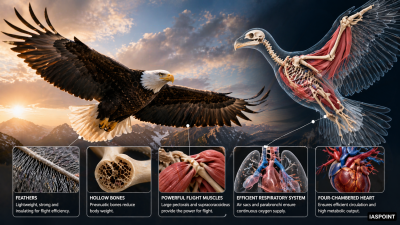
Flight is the most defining characteristic of birds, requiring a profound modification of almost every organ system.
Morphological Adaptations
Streamlined Body
The avian body is spindle-shaped, offering minimum resistance to air during flight. This “aerodynamic” profile allows birds to move through the atmosphere with high efficiency.
Modification of Forelimbs
The forelimbs are entirely transformed into wings. The flight surface is expanded by feathers, which are lightweight and replaceable.
Short Tail
The tail is significantly reduced to a muscular stub called the pygostyle, which supports the tail feathers (rectrices). These feathers act as a rudder for steering, balancing, and as a brake during landing.
Anatomical Adaptations (Skeletal and Muscular)
Pneumatic Bones
The long bones are hollow and filled with air sacs rather than heavy bone marrow. This significantly reduces body weight while maintaining structural strength through internal struts.
Fusion of Skeletal Elements
To provide a rigid frame for flight, many bones are fused:
- Synsacrum: The fusion of posterior vertebrae with the pelvic girdle to support the impact of landing.
- Wishbone (Furcula): The fused clavicles act like a spring, maintaining the distance between shoulders during the wing beat.
- Pygostyle: The terminal fused vertebrae of the tail.
Flight Muscles
The flight muscles are massive, accounting for nearly 15% to 25% of the total body weight.
- Pectoralis Major: The largest muscle, responsible for the powerful downstroke.
- Supracoracoideus: Responsible for the upstroke; it is uniquely positioned under the pectoralis and uses a “pulley-like” tendon to lift the wing.
Physiological and Internal Adaptations
Efficient Respiratory System
Birds possess Air Sacs (usually nine) that act as bellows. This ensures a “unidirectional” flow of air, meaning the lungs receive oxygenated air during both inhalation and exhalation. This is known as double respiration, which meets the high oxygen demand of flight.
Circulatory System
- Four-chambered Heart: Ensures complete separation of oxygenated and deoxygenated blood.
- High Heart Rate: Birds have exceptionally high heart rates and blood pressure to transport nutrients and oxygen rapidly to flight muscles.
Digestive and Excretory Efficiency
- Rapid Digestion: Birds possess a high metabolic rate; food is processed quickly to keep the body light.
- Absence of Urinary Bladder: To avoid carrying the extra weight of liquid urine, birds excrete nitrogenous waste as semi-solid Uric Acid (Uricotelism).
- Toothless Jaws: Teeth are replaced by a lightweight keratinous beak, shifting the center of gravity toward the middle of the body.
Sensory and Brain Adaptations
- Large Cerebellum: The part of the brain responsible for muscular coordination and equilibrium is highly developed to manage the complexities of three-dimensional movement.
- Optic Lobes: Highly developed for superior vision, allowing birds to navigate at high speeds and spot prey from great distances.
Summary Table: Weight Reduction vs. Power Generation
| Category | Adaptation for Weight Reduction | Adaptation for Power Generation |
| Skeletal | Pneumatic (hollow) bones; no teeth. | Keeled sternum for muscle attachment. |
| Excretory | No urinary bladder; uricotelic. | Efficient nutrient absorption. |
| Respiratory | Air sacs reduce specific gravity. | Double respiration (unidirectional flow). |
| Reproductive | Single ovary (usually left) in females. | High metabolic rate (Endothermy). |
Trivia for Aspirants
- The Gizzard: Since birds lack teeth, they use a muscular gizzard, often containing swallowed pebbles (gastroliths), to mechanically grind food.
- Hovering Flight: Hummingbirds are the only birds capable of sustained hovering and flying backward, achieved by a specialized “figure-eight” wing motion.
- Wing Loading: The ratio of body mass to wing area. Birds with low wing loading (like Vultures) can soar on thermals with minimal effort, whereas those with high wing loading (like Ducks) must flap constantly.