

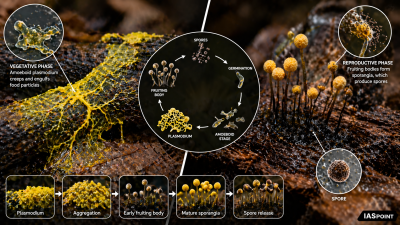
Slime moulds are saprophytic protists that exhibit characteristics of both fungi (in their reproductive phase) and amoebae (in their vegetative phase). They are primarily found on decaying twigs and leaves, where they move along organic matter, engulfing food particles.
Vegetative Phase: The Plasmodium
Under favorable conditions, slime moulds form an aggregation called a Plasmodium.
- Structure: A plasmodium is a multi-nucleated mass of protoplasm without a cell wall. It can grow and spread over several feet.
- Movement: It moves in an amoeboid fashion, streaming across surfaces to consume bacteria, fungal spores, and organic debris.
- Nutrition: They are strictly saprophytic, absorbing or engulfing nutrients from dead organic matter.
Reproductive Phase: Fruiting Bodies
When conditions become unfavorable (e.g., lack of moisture or food), the slime mould undergoes a dramatic transformation.
- Differentiation: The plasmodium differentiates to form stalked, spore-bearing structures called fruiting bodies.
- Spore Formation: The fruiting bodies produce spores at their tips.
- Resilience: The spores possess true cell walls (unlike the vegetative state), making them extremely resistant to adverse environmental conditions like extreme heat or drought.
- Dispersal: Spores can survive for many years and are eventually dispersed by air currents to germinate in favorable environments.
Classification: Acellular vs. Cellular Slime Moulds
Slime moulds are broadly divided based on their cellular organization during the vegetative stage.
| Feature | Acellular (Myxomycetes) | Cellular (Acrasiomycetes) |
| Vegetative State | Diploid (2n), multinucleated plasmodium | Haploid (n), individual amoeboid cells |
| Cell Boundaries | No internal cell boundaries (Coenocytic) | Distinct individual cells (Pseudoplasmodium) |
| Example | Physarum polycephalum | Dictyostelium discoideum |
Ecological and Scientific Significance
- Nutrient Cycling: As decomposers, they play a vital role in forest ecosystems by breaking down plant matter and regulating bacterial populations.
- Biological Research: Physarum polycephalum is a model organism used in research to study cytoplasmic streaming, cell cycle regulation, and even primitive “intelligence” (path-finding and memory).
- Taxonomic Position: They serve as an evolutionary link between unicellular protists and multicellular fungi, though they are genetically distinct from true fungi (whose cell walls are made of chitin).
Key Facts for UPSC Prelims
- Wall Composition: The vegetative body lacks a cell wall, but the spores contain cellulose in their walls. This is a critical distinction for identification.
- Movement: Their movement is governed by “cytoplasmic streaming,” a process involving actin and myosin filaments similar to human muscle cells.
- Habitat: They thrive in damp, shaded environments, particularly in forest floors with high leaf litter.
- Intelligence Trivia: Research has shown that slime moulds can solve mazes to find the shortest path to food, a fact often cited in discussions regarding biological intelligence without a nervous system.
Comparison: Slime Moulds vs. Fungi
| Feature | Slime Moulds | True Fungi |
| Kingdom | Protista | Fungi |
| Vegetative Body | Plasmodium (naked protoplasm) | Mycelium (hyphae with walls) |
| Cell Wall Material | Cellulose (only in spores) | Chitin |
| Centrioles | Present | Absent (in most higher fungi) |
| Nutrition | Engulfing (Phagotrophic) | Absorptive (Osmotrophic) |