

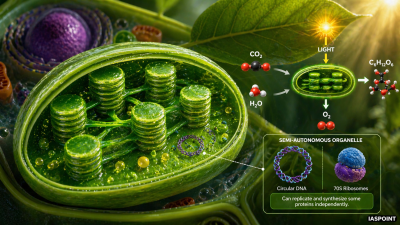
Chloroplasts are a specialized type of plastid that serve as the primary site for photosynthesis in eukaryotic cells. Found in green plants and algae, they convert light energy into chemical energy (glucose), sustaining life on Earth. Because they contain their own genetic material and can replicate independently of the nucleus, they are termed semi-autonomous organelles.
Structural Organization of the Chloroplast
The chloroplast is a double-membrane-bound organelle with a complex internal architecture designed to facilitate the light and dark reactions of photosynthesis.
1. The Envelope
- Outer Membrane: Relatively permeable to small molecules and ions.
- Inner Membrane: Highly selective and contains various transport proteins. It limits the inner space called the stroma.
- Intermembrane Space: A narrow space between the outer and inner membranes.
2. The Stroma
- A colorless, protein-rich aqueous matrix surrounding the thylakoids.
- Contains the enzymes necessary for the Calvin Cycle (Dark Reaction), which fixes Carbon Dioxide (CO2) into sugar.
- Houses circular DNA, RNA, and 70S ribosomes, enabling the chloroplast to synthesize some of its own proteins.
3. The Thylakoid System
- Thylakoids: Flattened, membranous sacs arranged in stacks. They contain the photosynthetic pigments (chlorophyll and carotenoids).
- Grana (singular: Granum): The stacks of thylakoids. This is the site of the Light Reaction, where light energy is trapped to produce ATP and NADPH.
- Stroma Lamellae: Membranous tubules that connect different grana, effectively increasing the efficiency of the photosynthetic apparatus.
Functional Mechanism: Two-Step Photosynthesis
The chloroplast partitions the process of photosynthesis into two distinct phases:
| Phase | Location | Primary Process |
| Light-Dependent Reaction | Thylakoid Membrane (Grana) | Light absorption, water splitting (H2O → O2), and formation of ATP and NADPH. |
| Light-Independent (Dark) Reaction | Stroma | Use of ATP and NADPH to convert CO2 into glucose (Carbon fixation). |
Chemical Composition
- Proteins: 35% to 55%
- Lipids: 20% to 30%
- Chlorophyll: 9%
- Carotenoids: 4.5%
- DNA & RNA: Trace amounts
Genetic and Evolutionary Significance
- Endosymbiotic Theory: Strong evidence suggests chloroplasts originated from ancestral Cyanobacteria (blue-green algae) that were engulfed by a primitive eukaryotic cell.
- Maternal Inheritance: In many plants, chloroplasts are inherited through the egg cell (ovule), similar to mitochondria in humans.
- Semiautonomy: While they have their own DNA, they still rely on the nuclear genome for the synthesis of many essential proteins.
UPSC Prelims Fact File and Trivia
- Photolysis of Water: This crucial step, which releases Oxygen (O2) as a byproduct, occurs specifically within the thylakoid lumen.
- Rubisco: The stroma contains the enzyme Ribulose-1,5-bisphosphate carboxylase/oxygenase (Rubisco), which is arguably the most abundant protein on Earth.
- Chlorophyll Structure: Chlorophyll contains a magnesium (Mg2+) ion at the center of its porphyrin ring, similar to how iron (Fe2+) is at the center of hemoglobin.
- Dimorphism: In certain plants (C4 plants like Maize and Sugarcane), chloroplasts are dimorphic—meaning they have different structures in mesophyll cells (with grana) and bundle sheath cells (without grana).
- Quantasomes: These are considered the functional units of photosynthesis located on the thylakoid membranes, consisting of about 230–250 chlorophyll molecules.