

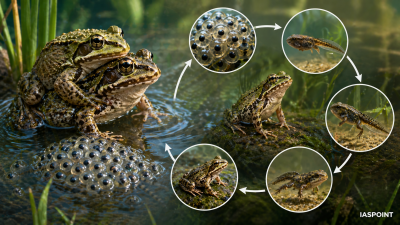
Reproduction in amphibians is characterized by a strong dependence on moist or aquatic environments. Most species exhibit Indirect Development, passing through a distinct larval stage that undergoes metamorphosis to reach adulthood.
1. Reproductive Modes and Fertilization
Amphibians employ various methods for fertilization, largely determined by their taxonomic order.
- External Fertilization: Dominant in Anura (frogs and toads). The male grips the female in a mating embrace called Amplexus, releasing sperm as the female sheds eggs into the water.
- Internal Fertilization:
- Caudata (Salamanders): The male deposits a protein capsule of sperm called a Spermatophore. The female picks it up with her cloaca.
- Gymnophiona (Caecilians): Males possess a specialized intromittent organ called a Phallodeum for direct internal fertilization.
2. The Amphibian Egg
Unlike reptiles and birds, amphibians produce Anamniotic eggs.
- Lack of Shell: Eggs are covered by a permeable, jelly-like membrane rather than a hard or leathery shell. This makes them highly susceptible to desiccation (drying out).
- Oviparity: Most amphibians are egg-layers. Eggs are typically laid in water, attached to aquatic vegetation, or in foam nests.
- Viviparity: Some caecilians and specific species of frogs are viviparous, giving birth to fully formed young.
3. Metamorphosis: From Larva to Adult
Metamorphosis is a thyroid-hormone-driven process that involves radical morphological and physiological changes.
| Feature | Larval Stage (Tadpole) | Adult Stage (Frog/Toad) |
| Habitat | Entirely Aquatic | Semi-terrestrial / Terrestrial |
| Respiration | Gills | Lungs and Skin |
| Locomotion | Tail with fin | Four limbs (Tail absorbed) |
| Feeding | Mostly Herbivorous | Strictly Carnivorous |
| Excretion | Ammonia (Ammonotelic) | Urea (Ureotelic) |
4. Parental Care in Amphibians
Amphibians exhibit a wide array of parental care behaviors to increase offspring survival rates.
- Egg Guarding: Many salamanders and frogs guard their egg clutches against predators and fungal infections.
- Transport: Some frogs (e.g., Poison Dart Frogs) carry tadpoles on their backs to move them from small terrestrial pools to larger bodies of water.
- Specialized Brooding: * Midwife Toad: The male wraps the egg strings around his hind legs and carries them until they are ready to hatch.
- Gastric Brooding Frog (Extinct): The female swallowed fertilized eggs, and the young developed in her stomach (which stopped producing acid during this period).
- Marsupial Frogs: Females carry eggs in a pouch on their back.
5. Unusual Reproductive Phenomena
- Neoteny (Paedomorphosis): The retention of juvenile or larval traits (like external gills) into the adult stage. The Axolotl is the most famous example; it becomes sexually mature while remaining in its larval form.
- Direct Development: Some species bypass the free-swimming larval stage entirely. The young hatch from eggs as miniature versions of the adults (common in many tropical “rain frogs”).
- Parthenogenesis: Certain populations of salamanders consist only of females and reproduce without the genetic contribution of males.
UPSC Prelims Fact File: Reproduction
- Hormonal Control: Metamorphosis is primarily regulated by the Thyroid Gland. If iodine (essential for thyroid hormones) is absent in the water, tadpoles may fail to transform into frogs.
- Breeding Triggers: In India, the monsoon is the primary trigger for mass amphibian breeding.
- Aposematism in Juveniles: Even in the larval stage, some tadpoles are toxic and display dark colors to warn fish predators.
- The Jelly Coat: The clear jelly surrounding amphibian eggs serves three purposes: protection from predators, insulation, and acting as a lens to concentrate solar heat for faster development.