

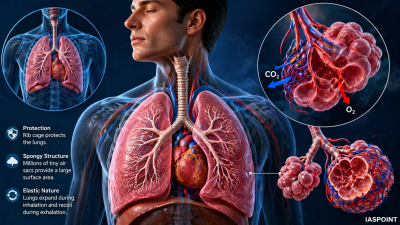
The lungs are the primary organs of respiration in humans, located in the thoracic cavity on either side of the heart. They are spongy, air-filled organs designed for the efficient exchange of gases.
Structural Organisation
The lungs are not identical in size or shape due to the anatomical positioning of other organs in the chest.
- The Right Lung: It is larger and heavier but shorter than the left lung (due to the upward displacement by the liver). It is divided into three lobes: Superior, Middle, and Inferior.
- The Left Lung: It is smaller and narrower to accommodate the heart. It features a concave depression called the Cardiac Notch. It is divided into two lobes: Superior and Inferior.
- Pleural Membranes: Each lung is enclosed by a double-layered serous membrane called the pleura.
- Outer Parietal Pleura: In contact with the thoracic lining.
- Inner Visceral Pleura: In contact with the lung surface.
- Pleural Fluid: Found between these layers, it reduces friction during lung expansion and contraction.
The Bronchial Tree
The lungs house a branching system of air passages that start from the trachea.
- Primary Bronchi: The trachea divides into right and left primary bronchi at the level of the 5th thoracic vertebra.
- Secondary and Tertiary Bronchi: These further branch into smaller tubes within the lobes.
- Bronchioles: The smallest branches that lack cartilaginous rings and terminate in alveolar sacs.
- Alveoli (The Functional Unit): There are approximately 300 million alveoli in the human lungs. They provide a massive surface area (nearly 70–100 square meters) for gas exchange.
Physiological Functions of the Lungs
The lungs perform several vital functions beyond the simple exchange of oxygen and carbon dioxide.
Gas Exchange (External Respiration)
The primary function is the diffusion of oxygen from the atmosphere into the blood and the removal of carbon dioxide from the blood into the atmosphere. This occurs across the respiratory membrane, which is composed of:
- The thin squamous epithelium of the alveoli.
- The endothelial lining of the alveolar capillaries.
- The basement substance between them.
Acid-Base Balance (pH Regulation)
The lungs help regulate the pH of the blood by adjusting the rate of CO2 removal.
- Hypoventilation: Increases CO2 levels, leading to Respiratory Acidosis.
- Hyperventilation: Decreases CO2 levels, leading to Respiratory Alkalosis.
Thermoregulation and Humidification
As air passes through the respiratory tract, the lungs help in warming it to body temperature and saturating it with water vapor, preventing the delicate alveolar tissues from drying out.
Protection and Filtration
- Mucociliary Escalator: Cilia and mucus trap dust and pathogens, moving them upward toward the pharynx to be swallowed or coughed out.
- Alveolar Macrophages: Specialized immune cells “dust cells” within the alveoli that ingest small particles and bacteria that bypass the upper defenses.
Lung Volumes and Vital Facts
| Parameter | Definition | Significance |
| Total Lung Capacity (TLC) | Total volume of air in lungs after maximum inspiration. | Approx. 5800–6000 mL in adults. |
| Functional Residual Capacity | Air remaining in lungs after normal expiration. | Prevents alveolar collapse. |
| Surfactant | A mixture of lipids and proteins secreted by Type II alveolar cells. | Reduces surface tension; prevents alveoli from sticking together. |
Clinical Conditions related to Lung Function
- Emphysema: A chronic disorder where alveolar walls are damaged, decreasing the respiratory surface area. It is majorly caused by cigarette smoking.
- Pneumonia: An infection that inflames the air sacs, which may fill with fluid or pus.
- Asthma: Difficulty in breathing causing wheezing due to inflammation and narrowing of the bronchi and bronchioles.
- Pneumothorax: A “collapsed lung” occurring when air leaks into the space between the lung and chest wall (pleural cavity).