

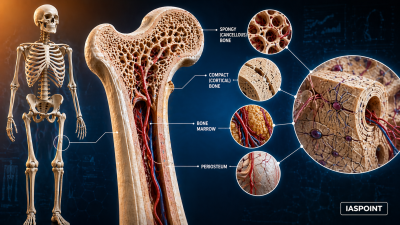
The structure of a bone is a sophisticated arrangement of organic and inorganic materials designed to provide maximum strength with minimum weight.
Macroscopic Structure of a Long Bone
A typical long bone, such as the femur or humerus, consists of several distinct regions characterized by their growth patterns and density.
- Diaphysis: The tubular shaft that runs between the proximal and distal ends of the bone. It is composed primarily of dense compact bone.
- Epiphysis: The expanded ends of the long bone, filled with spongy bone containing red bone marrow.
- Metaphysis: The narrow portion where the diaphysis meets the epiphysis. It contains the Epiphyseal Plate (growth plate) in growing children, which later becomes the Epiphyseal Line in adults.
- Articular Cartilage: A thin layer of hyaline cartilage covering the epiphysis where the bone forms a joint, reducing friction and absorbing shock.
- Periosteum: A fibrous, vascular membrane covering the outer surface of the bone (except at joints). It contains blood vessels, nerves, and lymphatic vessels that nourish the compact bone.
- Endosteum: A thin vascular membrane lining the inner Medullary Cavity.
- Medullary Cavity: The hollow central region of the diaphysis that houses Yellow Bone Marrow (adipose tissue) in adults.
Microscopic Structure: The Haversian System
At the microscopic level, compact bone is organized into a highly ordered system that allows for nutrient delivery to deeply embedded cells.
The Osteon (Haversian System)
The Osteon is the fundamental functional unit of compact bone.
- Central (Haversian) Canal: A longitudinal channel at the center of each osteon containing blood vessels and nerve fibers.
- Lamellae: Concentric rings of calcified matrix surrounding the central canal.
- Lacunae: Small spaces or “pockets” located between the lamellae which house mature bone cells (Osteocytes).
- Canaliculi: Tiny canals that radiate from the lacunae, connecting them to each other and the central canal. These allow for the exchange of nutrients and waste between osteocytes.
- Volkmann’s Canals: Perforating canals that run horizontally, connecting Haversian canals to each other and to the periosteum.
Chemical Composition of Bone Matrix
The bone matrix is a composite material that balances flexibility with hardness.
- Organic Component (35%): Primarily Collagen fibers and ground substance. This provides “tensile strength,” allowing the bone to resist stretching and twisting without snapping.
- Inorganic Component (65%): Mainly Hydroxyapatite, which is a crystallized form of Calcium Phosphate [Ca10(PO4)6(OH)2]. This provides “compressional strength” or hardness.
Bone Cells: The Remodeling Unit
Bone is a dynamic tissue that constantly undergoes remodeling through the action of four specific cell types.
| Cell Type | Function | Key Fact for Prelims |
| Osteoprogenitor Cells | Squamous stem cells. | The only bone cells to undergo cell division. |
| Osteoblasts | Bone-forming cells. | Synthesize and secrete collagen and calcium-binding proteins. |
| Osteocytes | Mature bone cells. | Derived from osteoblasts; act as sensors for mechanical stress. |
| Osteoclasts | Bone-resorbing cells. | Multinucleated cells that dissolve bone matrix using enzymes and acids. |
Comparative Table: Compact vs. Spongy Bone
| Feature | Compact Bone (Cortical) | Spongy Bone (Cancellous) |
| Structure | Dense, organized into Osteons. | Light, organized into Trabeculae. |
| Location | Outer layer of all bones; Diaphysis. | Inner layer; Epiphyses of long bones. |
| Function | Support, protection, weight-bearing. | Shock absorption, houses red marrow. |
| Blood Supply | Via Haversian and Volkmann canals. | Via diffusion from endosteum through marrow. |
Key Biological Concepts for UPSC
- Hematopoiesis: The process of blood cell production occurring in the red bone marrow of spongy bone.
- Calcium Homeostasis: Controlled by the endocrine system. Parathyroid Hormone (PTH) activates osteoclasts to release calcium into the blood when levels are low.
- Wolff’s Law: A biological principle stating that bone grows or remodels in response to the forces or demands placed upon it (mechanical stress).
- Bone vs. Cartilage: Unlike bone, cartilage is avascular (lacks blood vessels) and heals much slower. Cartilage’s matrix is composed of chondroitin salts, whereas bone matrix contains calcium salts.