

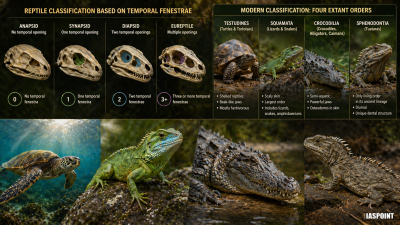
The classification of reptiles is primarily based on the structure of the skull, specifically the presence and number of openings (temporal fenestrae) in the temporal region. This anatomical feature was historically used to trace their evolutionary lineages. Modern classification focuses on four extant (living) orders.
1. Order Testudines (Chelonia)
This order comprises reptiles characterized by a bony or leathery shell that encases the body. They are unique among vertebrates as their shoulder and pelvic girdles are located inside the rib cage.
- Anatomy: The shell consists of a dorsal carapace and a ventral plastron. They lack teeth and instead possess a keratinized beak.
- Examples: ” Chelone (Turtle): Marine dwelling with paddle-like limbs.
- Testudo (Tortoise): Terrestrial with heavy, stumpy limbs.
- Trionyx (Soft-shelled turtle): Found in freshwater bodies in India.
- UPSC Fact: The Olive Ridley Turtle is a member of this order, famous for “Arribada” (mass nesting) on the Odisha coast.
2. Order Squamata
Squamata is the largest and most diverse order of reptiles, comprising lizards and snakes. They are distinguished by their skin covered in horny scales or shields and a quadrate bone that allows for extreme jaw mobility.
- Sub-order Lacertilia (Lizards): ” Possess external ear openings and movable eyelids.
- Most have four limbs and the ability for autotomy (self-amputation of the tail to escape predators).
- Examples: Hemidactylus (Wall Lizard), Chamaeleon (Tree Lizard), Calotes (Garden Lizard/Girgit).
- Sub-order Ophidia (Snakes): ” Limbless, lack external ear openings, and have fused eyelids (spectacles).
- Possess specialized ventral scales for locomotion.
- Examples: Bungarus (Krait), Vipera (Viper), Python (Ajgar).
- UPSC Fact: The King Cobra (Ophiophagus hannah) is the only snake in the world that builds a nest for its eggs.
3. Order Crocodilia
This order includes the largest and most complex living reptiles. They are semi-aquatic predators and are evolutionary closer to birds than to other reptiles.
- Anatomy: They are the only reptiles with a four-chambered heart. They possess a powerful tail, webbed feet, and a thick skin reinforced by bony plates called osteoderms.
- Examples: ” Crocodylus (Crocodile): Found in both fresh and saltwater.
- Gavialis (Gharial): Distinguished by a long, narrow snout; endemic to the Indian subcontinent.
- Alligator: Primarily found in the Americas and China (lacks the visible fourth lower tooth when the mouth is closed).
- UPSC Fact: The Gharial is a “Critically Endangered” species, with its primary habitat in the National Chambal Sanctuary.
4. Order Rhynchocephalia
This order is nearly extinct, represented today by only one genus. They are often referred to as “living fossils” because they have remained largely unchanged for over 200 million years.
- Anatomy: They possess a well-developed parietal eye (third eye) on top of the head, which is sensitive to light.
- Representative: Sphenodon (Tuatara).
- Distribution: Found exclusively on offshore islands of New Zealand.
Comparison Table of Reptilian Orders
| Feature | Testudines | Squamata | Crocodilia | Rhynchocephalia |
| Body Covering | Bony Shell | Horny Scales | Thick Scutes/Plates | Granular Scales |
| Heart | 3-Chambered | 3-Chambered | 4-Chambered | 3-Chambered |
| Teeth | Absent (Beak) | Present (Pleurodont) | Present (Thecodont) | Present (Acrodont) |
| Ears | No external opening | External opening (Lizards) | Ear Flaps | No external opening |
| Habitat | Marine/Land/Freshwater | Diverse Terrestrial | Semi-aquatic | Terrestrial Islands |
Evolution-based Classification (Skull Type)
| Type | Description | Representative Group |
| Anapsid | No temporal openings in the skull. | Ancestral reptiles and Turtles (Testudines). |
| Diapsid | Two pairs of temporal openings. | Lizards, Snakes, Crocodiles, and Birds. |
| Synapsid | One pair of low temporal openings. | Mammal-like reptiles (Ancestors of Mammals). |
Important Indian Reptiles in News
- Red Sanders/Red Sand Boa: Often smuggled due to the superstition that they bring luck or have medicinal properties. It is a non-venomous snake.
- Leith’s Softshell Turtle: Recently moved to CITES Appendix I to ensure its survival against illegal trade.
- Indian Star Tortoise: Frequently confiscated at airports; listed as ‘Vulnerable’ on the IUCN Red List.