

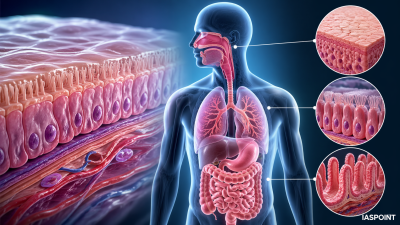
In the human body, epithelial tissue serves as the primary interface between the internal environment and the outside world.
Simple Epithelium: Single Layer Specialization
Simple epithelium is composed of a single layer of cells and is typically found where absorption, secretion, and filtration occur.
Simple Squamous Epithelium
- Structure: Extremely thin, flat cells with irregular boundaries, appearing like floor tiles (pavement epithelium).
- Location: Walls of blood vessels (endothelium), air sacs of lungs (alveoli), and lining of the heart.
- Function: Primarily involved in forming a diffusion boundary for gases and small molecules.
Simple Cuboidal Epithelium
- Structure: Cube-like cells with a central, spherical nucleus.
- Location: Tubular parts of nephrons in kidneys, ducts of glands (salivary, pancreatic), and the surface of ovaries.
- Function: Specialized for secretion and absorption. The epithelium of proximal convoluted tubules (PCT) of nephrons often has microvilli to increase surface area.
Simple Columnar Epithelium
- Structure: Tall and slender cells with nuclei located at the base.
- Location: Lining of the stomach, small intestine, and gall bladder.
- Function: Facilitates secretion of enzymes and mucus, and the absorption of nutrients.
Ciliated Epithelium
- Structure: Cuboidal or columnar cells possessing fine hair-like protoplasmic outgrowths called cilia on their free surface.
- Location: Inner surface of hollow organs like the fallopian tubes (to move the ovum) and bronchioles (to move mucus).
- Function: To move particles or mucus in a specific direction over the epithelium.
Compound (Stratified) Epithelium: Multi-layered Protection
Unlike simple epithelium, compound epithelium consists of multiple layers of cells. It has a limited role in secretion and absorption.
- Primary Function: To provide protection against mechanical, chemical, thermal, and osmotic stresses.
- Locations:
- Dry Surface of Skin: Keratinized stratified squamous epithelium (contains the protein keratin for waterproofing).
- Moist Surface of Buccal Cavity: Non-keratinized.
- Pharynx and Inner Lining of Ducts: Salivary glands and pancreatic ducts.
Glandular Epithelium: Secretory Specialization
Some columnar or cuboidal cells get specialized for secretion and are called glandular epithelium.
| Type | Description | Examples |
| Unicellular | Isolated glandular cells. | Goblet cells of the alimentary canal. |
| Multicellular | Cluster of cells forming a gland. | Salivary glands, Sweat glands. |
Exocrine vs. Endocrine Glands
- Exocrine Glands: These glands possess ducts. They secrete mucus, saliva, earwax, oil, milk, and digestive enzymes into specific sites.
- Endocrine Glands: These are ductless glands. Their products, called hormones, are secreted directly into the fluid bathing the gland (blood).
Specialized Cellular Junctions
Epithelial cells are held together by little intercellular material. Three types of specialized junctions are critical for tissue integrity:
- Tight Junctions: Help to stop substances from leaking across a tissue.
- Adhering Junctions: Perform cementing to keep neighboring cells together.
- Gap Junctions: Facilitate communication between cells by connecting the cytoplasm for rapid transfer of ions and small molecules.
Fact Sheet for UPSC Prelims
- Basement Membrane: Epithelial tissues lack blood vessels (avascular) and always rest on a non-cellular basement membrane that provides structural support and nutrition via diffusion from underlying connective tissue.
- Germ Layer Origin: Epithelium is unique because it can originate from the Ectoderm (skin), Mesoderm (lining of coelom), or Endoderm (lining of the gut).
- Pseudo-stratified Epithelium: Appears multi-layered due to nuclei being at different levels, but all cells touch the basement membrane. It is found in the human trachea.
- Transitional Epithelium: A specialized stratified epithelium that can stretch (change shape); found in the urinary bladder and ureters.