

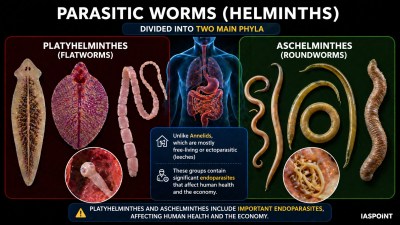
Parasitic worms, or helminths, are divided into two main phyla: Platyhelminthes (Flatworms) and Aschelminthes (Roundworms). Unlike Annelids, which are mostly free-living or ectoparasitic (leeches), these groups contain significant endoparasites that affect human health and the economy.
Phylum Platyhelminthes (Flatworms)
These are dorso-ventrally flattened, acoelomate organisms. Most are hermaphrodites and require one or more intermediate hosts to complete their life cycle.
1. Taeniasis (Tapeworm Infection)
- Pathogen: Taenia solium (Pork tapeworm) and Taenia saginata (Beef tapeworm).
- Transmission: Consumption of undercooked “measly” meat containing cysticercus larvae.
- Clinical Features: Abdominal pain, indigestion, and weight loss.
- Cysticercosis: A more severe condition where larvae migrate to the brain, lungs, or liver, causing seizures.
2. Fascioliasis (Liver Fluke)
- Pathogen: Fasciola hepatica.
- Transmission: Ingestion of watercress or aquatic plants contaminated with metacercariae.
- Target Organ: Bile ducts and liver.
- Economic Impact: Significant losses in livestock (sheep and cattle) due to reduced milk and meat production.
3. Schistosomiasis (Bilharzia)
- Pathogen: Schistosoma (Blood fluke).
- Transmission: Larvae (cercariae) penetrate human skin during contact with infested freshwater.
- Vector: Freshwater snails act as the intermediate host.
- Trivia: It is considered a “Neglected Tropical Disease” (NTD) by the WHO.
Phylum Aschelminthes (Roundworms)
These are pseudocoelomate, cylindrical worms. They are often dioecious (separate sexes), with females typically being longer than males.
1. Ascariasis
- Pathogen: Ascaris lumbricoides (Common Roundworm).
- Transmission: Fecal-oral route via contaminated food or water.
- Impact: Internal bleeding, muscular pain, fever, and blockage of the intestinal passage.
- Fact: It is the most common helminthic infection in humans worldwide.
2. Lymphatic Filariasis (Elephantiasis)
- Pathogen: Wuchereria bancrofti and Wuchereria malayi.
- Transmission: Biting of infected female Culex mosquitoes.
- Pathology: The worms reside in the lymphatic vessels, causing chronic inflammation and massive swelling of lower limbs and genital organs.
- Government Initiative: The National Vector Borne Disease Control Programme (NVBDCP) in India aims for the elimination of Lymphatic Filariasis.
3. Ancylostomiasis (Hookworm Infection)
- Pathogen: Ancylostoma duodenale.
- Transmission: Larvae in soil penetrate the skin of bare feet.
- Clinical Features: Severe anemia (as the worms suck blood from the intestinal wall) and iron deficiency.
Comparative Analysis of Major Helminthic Diseases
| Disease | Pathogen Type | Primary Vector/Mode | Major Symptoms |
| Enterobiasis | Roundworm (Pinworm) | Direct contact/Fecal-oral | Perianal itching, especially in children. |
| Dracunculiasis | Roundworm (Guinea worm) | Contaminated drinking water | Blisters on legs; India is certified Guinea-worm free. |
| Trichinosis | Roundworm (Trichinella) | Undercooked pork | Muscle pain and swelling of eyelids. |
| Echinococcosis | Flatworm (Dog Tapeworm) | Contact with infected dogs | Hydatid cysts in liver or lungs. |
National Health Programs and Interventions
Given the high prevalence of soil-transmitted helminths (STH) in India, the government has launched specific interventions:
- National Deworming Day (NDD): Conducted twice a year (February 10 and August 10) to deworm children aged 1–19 years.
- Drug of Choice: Albendazole (400mg) is the chewable tablet distributed by the Ministry of Health and Family Welfare.
- WASH Initiative: Water, Sanitation, and Hygiene (WASH) are critical to breaking the transmission cycle of roundworms and hookworms.
Important Facts for UPSC Prelims
- Intermediate Host: An organism that supports the immature or non-reproductive forms of a parasite (e.g., Snail for Liver fluke, Pig for Tapeworm).
- Definitive Host: The organism in which the parasite reaches maturity and reproduces sexually (usually Humans).
- Bio-indicator: The presence of certain parasitic worms in water bodies can sometimes indicate the level of fecal contamination and organic pollution.
- Vector Distinction: While malaria is protozoan and spread by Anopheles, Filariasis is helminthic and spread primarily by Culex.