

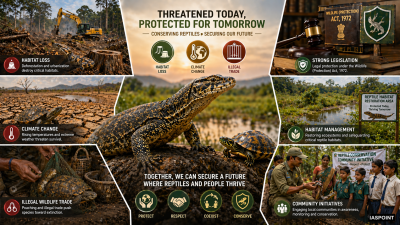
Reptiles are among the most threatened vertebrate groups globally, facing pressures from habitat loss, climate change, and illegal wildlife trade. In India, conservation efforts are multidimensional, involving legislative protection, habitat management, and community-led initiatives.
1. Major Threats to Reptilian Biodiversity
- Habitat Fragmentation: Conversion of wetlands and forests for agriculture and infrastructure disrupts the migratory paths of species like the King Cobra.
- Illegal Wildlife Trade: High demand for “Exotic Pets” (e.g., Indian Star Tortoise), tortoise shells, and snake skins for the fashion industry.
- Climate Change: Rising temperatures significantly impact species with Temperature-Dependent Sex Determination (TSD), such as turtles and crocodiles, leading to skewed sex ratios and population collapse.
- Anthropogenic Pressure: Sand mining in riverbeds destroys the nesting sites of the Gharial and various freshwater turtles.
- Bycatch: Marine turtles often drown after being accidentally caught in the nets of commercial fishing trawlers.
2. Legislative Protection in India
The primary legal instrument for reptile conservation is the Wildlife (Protection) Act (WPA), 1972.
- Schedule I: Provides absolute protection; offenses involve the highest penalties.
- Examples: Gharial, Golden Gecko, Indian Python, Olive Ridley Turtle, Hawksbill Turtle.
- Schedule II: Includes species with high protection but slightly lower penalties than Schedule I.
- Examples: King Cobra, Indian Monitor Lizard, various Rat Snakes.
- WCCB (Wildlife Crime Control Bureau): A statutory multi-disciplinary body established to combat organized wildlife crime in the country.
3. Targeted Conservation Projects in India
Project Crocodile (1975)
Launched with support from the UNDP and FAO, this project aimed to revive the dwindling populations of India’s three crocodilian species.
- Species Covered: Gharial (Gavialis gangeticus), Mugger (Crocodylus palustris), and Saltwater Crocodile (Crocodylus porosus).
- Methodology: “Rear and Release” technique—eggs are collected from the wild, hatched in captivity, and juveniles are released into protected habitats once they reach a size less vulnerable to predators.
Sea Turtle Conservation
- Operation Save Kurma: A species-specific operation by the WCCB to stop the illegal trade of live turtles and tortoises.
- Turtle Excluder Devices (TEDs): The government has made it mandatory for mechanized trawlers to use TEDs—a specialized grid that allows turtles to escape from fishing nets.
- Integrated Coastal Zone Management (ICZM): Focuses on protecting mass nesting sites (Arribada) in Odisha.
4. International Conventions and Status
| Convention / Organization | Role in Reptile Conservation |
| CITES | Regulates international trade in endangered reptiles. Most Indian species are in Appendix I or II. |
| IUCN Red List | Provides the “threat status.” For example, the Gharial is Critically Endangered, while the Olive Ridley is Vulnerable. |
| CMS (Bonn Convention) | Focuses on migratory species like Sea Turtles that cross international boundaries. |
5. Important Conservation Sites in India
- National Chambal Sanctuary (MP/UP/Rajasthan): The most critical habitat for the Critically Endangered Gharial and the Red-crowned Roofed Turtle.
- Bhitarkanika National Park (Odisha): Holds the world’s largest population of Saltwater Crocodiles and serves as a major nesting site for Olive Ridleys.
- Gahirmatha Marine Sanctuary (Odisha): The world’s largest known rookery of Olive Ridley Sea Turtles.
- Agumbe Rainforest Research Station (Karnataka): A pioneer in the study and conservation of the King Cobra.
6. Conservation Management Strategies
- In-situ Conservation: Protecting the natural habitat through National Parks and Sanctuaries (e.g., Turtle Sanctuaries in Varanasi).
- Ex-situ Conservation: Captive breeding centers like the Madras Crocodile Bank Trust (MCBT), which serves as a gene bank for several species.
- Community Participation: Engaging tribes like the Irulas of Tamil Nadu for venom extraction and snake rescue operations, turning traditional hunters into conservationists.
- Ecotourism: Promoting responsible tourism that provides alternative livelihoods to locals who might otherwise engage in poaching.
7. Trivia for UPSC Prelims
- Living Fossil: The Tuatara is the only survivor of an entire order (Rhynchocephalia) and is a high priority for global conservation.
- Indicator Species: The health of the Gharial population is considered a direct indicator of the cleanliness of the Ganga and Chambal river systems.
- Operation Olivia: An annual operation conducted by the Indian Coast Guard to protect Olive Ridley turtles during their breeding and nesting season along the Odisha coast.