

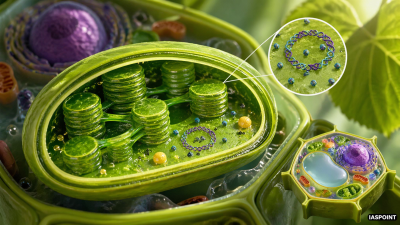
Plastids are large, double-membrane-bound organelles found in the cells of all plants and in some protists like Euglenoids. They are primary sites of manufacturing and storing important chemical compounds used by the cell. Like mitochondria, plastids are semi-autonomous organelles, containing their own circular DNA and 70S ribosomes.
Classification of Plastids
Based on the presence or absence of specific pigments and their resulting color, plastids are classified into three distinct types:
1. Chloroplasts
- Pigments: Contain chlorophyll and carotenoid pigments.
- Function: Responsible for trapping light energy essential for photosynthesis.
- Location: Predominantly found in the mesophyll cells of leaves.
2. Chromoplasts
- Pigments: Contain fat-soluble carotenoid pigments like carotene and xanthophylls.
- Function: Provide specific colors (yellow, orange, or red) to flowers and fruits, which aids in attracting pollinators and agents for seed dispersal.
3. Leucoplasts
These are colorless plastids of varied shapes and sizes that function as storage units:
- Amyloplasts: Store carbohydrates (starch), e.g., in potato tubers.
- Elaioplasts: Store oils and fats.
- Aleuroplasts (Proteinoplasts): Store proteins.
Structure of the Chloroplast
The chloroplast is the most studied member of the plastid family. Its internal organization is complex to maximize photosynthetic efficiency.
- Membrane System: It is bounded by a double membrane. The inner membrane is relatively less permeable than the outer membrane.
- Stroma: The space limited by the inner membrane. It contains enzymes required for the synthesis of carbohydrates and proteins.
- Thylakoids: A number of organized flattened membranous sacs present in the stroma. Chlorophyll pigments are located in the thylakoid membranes.
- Grana: Thylakoids are arranged in stacks like piles of coins called grana (singular: granum).
- Stroma Lamellae: Flat membranous tubules connecting the thylakoids of different grana.
Functions of Plastids
| Type | Primary Function | Example |
| Chloroplast | Photosynthesis (Food production) | Green leaves |
| Chromoplast | Pigmentation (Attraction) | Ripe tomatoes, Carrot roots |
| Amyloplast | Starch storage | Rice, Wheat, Potato |
| Elaioplast | Fat/Oil storage | Castor seeds |
| Aleuroplast | Protein storage | Maize grains |
Key Comparisons: Mitochondria vs. Chloroplasts
| Feature | Mitochondria | Chloroplast |
| Occurrence | All eukaryotic cells | Only in plant cells and algae |
| Function | Cellular Respiration (ATP generation) | Photosynthesis (Sugar production) |
| Internal Folds | Called Cristae | Called Thylakoids (Grana) |
| Pigments | Absent | Present (Chlorophyll) |
| Metabolic Nature | Catabolic (Breaks down food) | Anabolic (Synthesizes food) |
UPSC Prelims Fact File and Trivia
- Endosymbiotic Origin: Similar to mitochondria, plastids are believed to have evolved from symbiotic cyanobacteria (blue-green algae) that lived inside early eukaryotic cells.
- DNA and Ribosomes: Plastids possess double-stranded circular DNA and 70S ribosomes, which is a prokaryotic characteristic.
- Inter-convertibility: Plastids can change from one type to another. For example, when a tomato ripens, its chloroplasts (green) transform into chromoplasts (red) due to the breakdown of chlorophyll and synthesis of carotenoids.
- Etioplasts: These are plastids that develop in plants grown in the dark. Once exposed to light, they quickly convert into chloroplasts.
- Pigment Facts: The orange color of carrots is due to β-carotene, while the red color of tomatoes is due to lycopene, both stored in chromoplasts.