

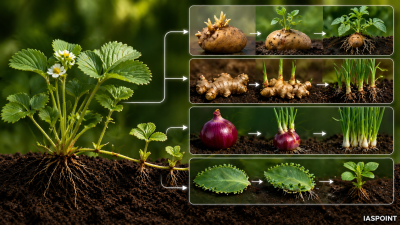
Natural vegetative propagation is a form of asexual reproduction where a new plant grows from a fragment or specialized reproductive structure of the parent plant.
Classification by Vegetative Propagules
Plants utilize different organs—roots, stems, and leaves—to achieve natural multiplication. The primary evolutionary advantage is the ability to bypass the vulnerable seedling stage.
1. Underground Stem Modifications
Plants store nutrients in these structures to survive dormancy (perennation) and then sprout new aerial shoots.
- Rhizomes: Thickened, prostrate stems growing horizontally beneath the soil. They possess nodes, internodes, and scale leaves.
- Examples: Ginger (Zingiber officinale), Turmeric, Lotus, Canna, and Banana.
- Tubers: The swollen terminal ends of specialized underground branches. They feature “eyes,” which are actually axillary buds protected by scale leaves.
- Example: Potato (Solanum tuberosum).
- Bulbs: Highly reduced discoid stems surrounded by fleshy, food-storing scale leaves.
- Examples: Onion, Garlic, Tulips, and Lilies.
- Corms: Unbranched, swollen underground stems that grow vertically. They store more food than rhizomes.
- Examples: Colocasia (Taro), Crocus, and Amorphophallus (Zamikand).
2. Sub-aerial Stem Modifications
These modifications are common in plants with weak stems that spread over the soil or water surface.
- Runners: Narrow, green, horizontal branches that develop from the base of the crown and root at nodes to form new plants.
- Examples: Lawn Grass (Cynodon dactylon), Oxalis, and Centella (Brahmi).
- Offsets: Found primarily in aquatic plants; these are shorter and thicker than runners, originating from the leaf axil.
- Examples: Water Hyacinth (Eichhornia) and Water Lettuce (Pistia).
- Suckers: These arise from the underground part of the main stem, grow horizontally under the soil for some distance, and then emerge obliquely upward.
- Examples: Chrysanthemum, Mint, and Pineapple.
- Stolons: Slender lateral branches that arise from the base of the main axis and arch down to touch the ground and form new roots.
- Examples: Wild Strawberry, Jasmine, and Peppermint.
3. Propagation via Roots and Leaves
Some plants have evolved to use non-stem organs for vegetative multiplication.
- Foliar Buds (Leaves): Adventitious buds develop along the notches of the leaf margins. When the leaf falls on moist soil, these buds sprout into independent plantlets.
- Examples: Bryophyllum (Sprout leaf plant), Begonia, and Kalanchoe.
- Vegetative Roots: Certain tap roots or adventitious roots develop adventitious buds that grow into leafy shoots (slips).
- Examples: Sweet Potato (Ipomoea batatas), Dahlia, Asparagus, and Guava.
Comparative Summary Table
| Propagule | Organ Type | Key Feature | UPSC Example |
| Eye | Tuber (Stem) | Axillary bud in a depression | Potato |
| Rhizome | Underground Stem | Horizontal growth; nodes/internodes | Ginger / Banana |
| Bulbil | Floral/Vegetative Bud | Fleshy bud for propagation | Agave / Dioscorea |
| Offset | Sub-aerial Stem | Lateral branch of one internode length | Water Hyacinth |
| Leaf Buds | Leaf Margin | Adventitious buds on leaf notches | Bryophyllum |
Ecological and Evolutionary Significance
- Rapid Colonization: Enables plants like Eichhornia (Water Hyacinth) to cover vast water bodies in short periods, earning it the title “Terror of Bengal.”
- Genetic Stability: Ensures that the offspring are identical to the parent, which is beneficial in stable environments but a disadvantage during environmental stress due to lack of variation.
- Perennation: Underground structures allow the plant to survive extreme cold or drought by remaining dormant until favorable conditions return.
- Economic Utility: Farmers use these natural tendencies to multiply crops like Sugarcane (via stem nodes) and Banana (via rhizomes) efficiently without the cost of hybrid seeds.
UPSC Prelims Trivia: Fact Check
- Is a Sweet Potato a Tuber? Technically, a Potato is a Stem Tuber, whereas a Sweet Potato is a Root Tuber. Both are used for vegetative propagation but originate from different plant organs.
- Banana Reproduction: Though bananas have seeds in the wild, the commercial Cavendish banana is sterile and reproduces exclusively via Rhizomes/Suckers.
- Agave: Unlike most plants that use stems or roots, Agave uses Bulbils, which are modified floral buds that develop into plantlets while still on the parent stalk.