

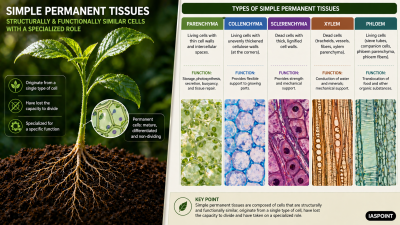
Simple permanent tissues are composed of cells that are structurally and functionally similar, originating from a single type of cell. These tissues have lost the capacity to divide and have taken on a specialized role.
1. Parenchyma: The Fundamental Tissue
Parenchyma is the most common and unspecialized plant tissue. It forms the “filler” or ground tissue in the soft parts of the plant, such as the cortex of roots, the mesophyll of leaves, and the pith of stems.
- Structure: Composed of living cells with thin primary cell walls made of cellulose. Cells are usually loosely packed with large intercellular spaces.
- Functions:
- Storage: Stores nutrients and water.
- Photosynthesis: When it contains chlorophyll, it is called Chlorenchyma.
- Buoyancy: In aquatic plants, large air cavities in parenchyma (called Aerenchyma) help the plant float.
- Secretory: Involved in the secretion of resins, tannins, and gums.
2. Collenchyma: The Flexible Support
Collenchyma provides mechanical support and elasticity to young, growing parts of the plant. It allows plants to bend without breaking.
- Structure: Composed of living cells. The cell walls are unevenly thickened at the corners due to the deposition of cellulose, hemicellulose, and pectin. There is very little intercellular space.
- Location: Found in leaf stalks (petioles), below the epidermis of dicot stems, and midribs of leaves. It is generally absent in monocots and roots.
- Functions:
- Mechanical Strength: Provides tensile strength to young stems.
- Flexibility: Allows the plant to withstand high-velocity winds.
3. Sclerenchyma: The Protective Armour
Sclerenchyma is the primary reinforcing tissue of plants. Unlike the other two, it is composed of dead cells at maturity.
- Structure: Cells have extremely thick, uniform walls impregnated with Lignin, a complex polymer that makes the walls waterproof and rigid. There are no intercellular spaces.
- Types:
- Fibres: Elongated, needle-like cells found in bundles (e.g., hemp, jute).
- Sclereids (Stone Cells): Spherical or oval cells with very narrow lumens. They provide the “gritty” texture to fruits like pears and the hardness to nutshells and seed coats.
- Functions:
- Rigidity: Provides structural strength to the plant body.
- Protection: Forms a protective covering around seeds and nuts.
Comparative Analysis of Simple Permanent Tissues
| Feature | Parenchyma | Collenchyma | Sclerenchyma |
| Cell State | Living | Living | Dead |
| Cell Wall | Thin (Cellulose) | Unevenly thick (Pectin) | Highly thick (Lignin) |
| Intercellular Space | Large | Small/Absent | Absent |
| Function | Storage/Metabolism | Flexibility/Support | Rigidity/Protection |
| Found in | Soft parts (Pith, Cortex) | Leaf stalks, Dicot stems | Wood, Nutshells, Fibres |
UPSC Prelims Facts and Trivia
- Pectin: The thickening agent in Collenchyma is Pectin, the same substance used to set jams and jellies.
- Lignin: Lignin is the second most abundant biological polymer on Earth after cellulose. It is responsible for the “woody” nature of plants.
- Epidermis: The outermost layer of cells in a plant is a specialized simple tissue that protects against water loss (often covered by a waxy Cuticle) and infection.
- Stomata: Within the epidermis, specialized guard cells (a type of modified parenchyma) regulate gas exchange and transpiration.
- Idioblasts: Specialized parenchyma cells that store non-protoplasmic materials like crystals (calcium oxalate), tannins, or oils.