

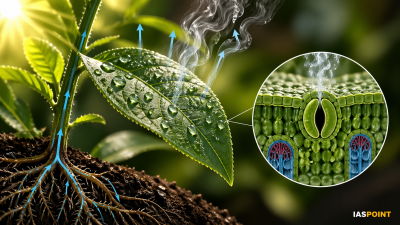
Transpiration is the physiological process of water loss from the aerial parts of the plant, primarily the leaves, in the form of water vapor. It is often described as a “necessary evil” because while it leads to water loss, it is essential for nutrient transport and temperature regulation.
Types of Transpiration
Plants lose water through different structures, categorized into three main types:
- Stomatal Transpiration: Occurs through the stomata on leaf surfaces. It accounts for 90-97% of total water loss.
- Cuticular Transpiration: Loss of water directly through the cuticle (the waxy layer on the epidermis). It is higher in plants with thin cuticles.
- Lenticular Transpiration: Occurs through lenticels (small openings in the woody bark of stems). It accounts for a negligible amount (less than 1%).
The Mechanism of Stomatal Movement
Stomata are tiny pores guarded by two specialized cells called Guard Cells. The opening and closing of stomata depend on the turgidity of these cells.
- Opening of Stomata: During the day, guard cells accumulate solutes (specifically K^+ ions), lowering their water potential. Water enters the guard cells, making them turgid. The outer thin walls bulge out, pulling the inner thick walls apart.
- Closing of Stomata: When the guard cells lose water (flaccidity) due to water stress or darkness, the inner walls regain their original shape, closing the pore.
Transpiration Pull and Ascent of Sap
The movement of water from roots to the top of the canopy is explained by the Cohesion-Tension-Transpiration Pull Theory.
- Cohesion: Mutual attraction between water molecules.
- Adhesion: Attraction of water molecules to the surface of tracheary elements (xylem walls).
- Surface Tension: Water molecules are attracted to each other in the liquid phase more than to water in the gas phase.
- Transpiration Pull: As water evaporates through stomata, it creates a “pull” or tension that is transmitted down to the roots through the continuous water column in the xylem.
Factors Affecting Transpiration
The rate of transpiration is influenced by both environmental and plant-specific factors.
| External Factor | Effect on Transpiration Rate |
| Light | Increases (stimulates stomatal opening). |
| Temperature | Increases (lowers relative humidity and increases kinetic energy). |
| Humidity | Decreases (high external humidity reduces the diffusion gradient). |
| Wind Speed | Increases (removes the water vapor layer around the leaf). |
- Plant Factors: Number and distribution of stomata, percent of open stomata, water status of the plant, and canopy structure.
Transpiration vs. Guttation
Aspirants must distinguish between these two forms of water loss.
| Feature | Transpiration | Guttation |
| Form of Water | Water vapor. | Liquid droplets. |
| Structure | Stomata, Cuticle, or Lenticels. | Hydathodes (vein endings). |
| Purity | Pure water. | Solution containing organic/inorganic salts. |
| Time | Mostly during the day/sunlight. | Early morning or late night. |
| Driving Force | Transpiration pull. | Root pressure. |
Significance of Transpiration
- Cooling Effect: It lowers leaf temperature by 10–15°C through evaporative cooling.
- Nutrient Transport: Facilitates the upward movement of minerals from the soil.
- Turgidity: Maintains the shape and structure of plants by keeping cells turgid.
- Photosynthesis: Provides the water necessary for the biosynthetic phase.
Critical Trivia for UPSC Prelims
- Antitranspirants: Substances used to reduce transpiration without affecting growth (e.g., Abscisic Acid (ABA), Phenylmercuric Acetate (PMA), and certain waxes).
- ABA (Abscisic Acid): Known as the stress hormone, it triggers stomatal closure during water scarcity.
- Potometer: An instrument used to measure the rate of transpiration by measuring the rate of water intake.
- Wilting: Occurs when the rate of transpiration exceeds the rate of water absorption, causing the plant to lose turgidity.
- K+ Ion Exchange Theory: The most widely accepted theory for stomatal movement, involving the active transport of Potassium ions into guard cells.