

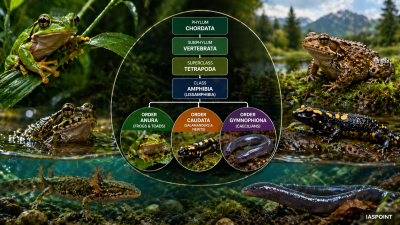
Amphibians belong to the Phylum Chordata, Subphylum Vertebrata, and Superclass Tetrapoda. Within the Class Amphibia, modern species (Lissamphibia) are categorized into three distinct Orders based on their morphological features, limb structure, and reproductive strategies.
1. Order Anura (Salientia)
This is the largest and most diverse order, comprising frogs and toads. The name “Anura” signifies the absence of a tail in the adult stage.
- Morphological Features: Short bodies, large heads, and highly developed hind limbs specialized for saltatorial (jumping) locomotion. They lack a neck and have a wide mouth with a sticky, protrusible tongue.
- Respiration: Adults primarily use lungs and moist skin, while larvae (tadpoles) use gills.
- Fertilization: Almost exclusively external, occurring in water. Eggs are typically laid in clusters (frogspawn) or strings (toadspawn).
- Indian Context: The Indian Bullfrog (Hoplobatrachus tigerinus) is the largest frog in India. The Purple Frog, found in the Western Ghats, remains underground for most of the year.
2. Order Caudata (Urodela)
This order includes salamanders and newts. Unlike Anurans, these amphibians retain their tails throughout their entire life cycle.
- Morphological Features: Elongated bodies with four limbs of roughly equal size. They possess a distinct neck and a long tail.
- Regeneration: Noted for their extraordinary ability to regenerate lost limbs, tails, and even parts of internal organs.
- Paedomorphosis: Some species, like the Axolotl, exhibit “neoteny,” where the adult retains larval characteristics like external gills.
- Fertilization: Mostly internal via spermatophores (capsules of sperm) deposited by males and picked up by females.
- Indian Context: The Himalayan Newt (Tylototriton verrucosus) is the only representative of this order in India, primarily found in Darjeeling, Sikkim, and Manipur.
3. Order Gymnophiona (Apoda)
This order consists of caecilians, which are limbless, serpentine amphibians often mistaken for snakes or earthworms.
- Morphological Features: Cylindrical, elongated bodies without limbs or girdles. They have a very short or absent tail.
- Sensory Adaptation: Most are fossorial (burrowing) and have rudimentary eyes covered by skin or bone. They possess a unique sensory tentacle between the eye and nostril to detect chemical cues.
- Skin: Unlike other amphibians, some caecilians have small, calcified scales embedded within their skin folds (annuli).
- Reproduction: Fertilization is internal. Some species are oviparous (egg-laying), while others are viviparous (giving birth to live young).
- Indian Context: India is a global hotspot for caecilians, with the genus Ichthyophis being widely distributed in the Western Ghats and Northeast India.
Comparative Summary of Amphibian Orders
| Feature | Anura (Frogs/Toads) | Caudata (Salamanders) | Gymnophiona (Caecilians) |
| Limbs | Four (Hind limbs longer) | Four (Equal size) | Absent |
| Tail | Absent in adults | Present in adults | Absent or very short |
| Fertilization | External (mostly) | Internal (mostly) | Internal |
| Larval Stage | Tadpole with gills | Larva with external gills | Some have aquatic larvae |
| Locomotion | Leaping/Swimming | Walking/Swimming | Burrowing/Sinuous crawling |
| Body Shape | Short and stout | Elongated | Worm-like/Serpentine |
Evolutionary Significance: The Labyrinthodonts
For UPSC Prelims, it is important to note the extinct ancestors. Labyrinthodonts were the primitive amphibians that first emerged from Sarcopterygian (lobe-finned) fish during the Devonian period.
- Ichthyostega: One of the earliest transitional fossils showing both fish-like (tail fin) and amphibian-like (limbs) traits.
- Seymouria: A transitional form once thought to bridge the gap between amphibians and early reptiles.
Key Evolutionary Landmarks
- Carboniferous Period: Known as the “Age of Amphibians” due to their dominance and diversification into various terrestrial niches.
- Anamniotic Eggs: A major evolutionary constraint; unlike reptiles, amphibians did not develop an amnion, necessitating a return to water or moist environments for reproduction.