

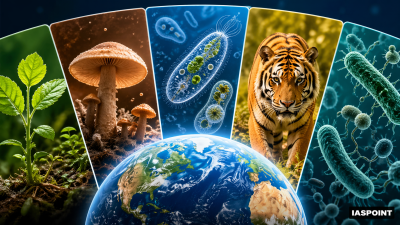
The Five Kingdom Classification is the most widely accepted system for categorizing life on Earth. Proposed by R.H. Whittaker in 1969, it replaced the traditional two-kingdom system by incorporating sophisticated criteria such as cellular complexity, body organization, and phylogenetic (evolutionary) relationships.
Primary Criteria for Classification
Whittaker utilized five specific parameters to differentiate between organisms:
- Complexity of Cell Structure: Distinction between Prokaryotic and Eukaryotic cells.
- Complexity of Organism: Distinction between Unicellular and Multicellular body organization.
- Mode of Nutrition: The primary factor for differentiation (Autotrophic, Absorptive Heterotrophic, or Ingestive Heterotrophic).
- Life Style: Categorization based on ecological roles as Producers (Plants), Consumers (Animals), and Decomposers (Fungi).
- Phylogenetic Relationships: Evolutionary history and ancestral links.
Detailed Analysis of the Five Kingdoms
1. Kingdom Monera (The Prokaryotes)
- Cell Type: Prokaryotic; lacks a defined nucleus and membrane-bound organelles.
- Cell Wall: Non-cellulosic (composed of Polysaccharides and Amino Acids/Peptidoglycan).
- Nutrition: Highly diverse; includes Chemo-autotrophs, Photo-autotrophs, Saprophytes, and Parasites.
- Examples: Bacteria, Cyanobacteria (Blue-Green Algae), and Mycoplasma (organisms that lack a cell wall entirely and can survive without oxygen).
2. Kingdom Protista (Unicellular Eukaryotes)
- Cell Type: Eukaryotic; contains a well-defined nucleus and organelles.
- Habitat: Primarily aquatic.
- Linkage: This kingdom acts as an evolutionary bridge between Monera and the multicellular kingdoms (Fungi, Plantae, Animalia).
- Groups:
- Chrysophytes: Diatoms and Golden algae; chief producers in the oceans.
- Dinoflagellates: Mostly marine; cause “Red Tides” (e.g., Gonyaulax).
- Euglenoids: Mixotrophic (Photosynthetic in light, heterotrophic in dark).
- Slime Moulds: Saprophytic protists.
- Protozoans: Predators or parasites (e.g., Amoeba, Plasmodium).
3. Kingdom Fungi (Multicellular Decomposers)
- Cell Type: Eukaryotic.
- Cell Wall: Present, composed of Chitin and polysaccharides.
- Nutrition: Heterotrophic (Saprophytic or Parasitic).
- Unique Feature: Except for Yeast (unicellular), fungi are filamentous, consisting of long, slender thread-like structures called hyphae.
- Examples: Agaricus (Mushroom), Puccinia (Wheat rust), Penicillium.
4. Kingdom Plantae (Multicellular Producers)
- Cell Type: Eukaryotic with prominent chloroplasts.
- Cell Wall: Present, primarily composed of Cellulose.
- Nutrition: Autotrophic (Photosynthetic).
- Life Cycle: Exhibits “Alternation of Generations” between the diploid sporophytic and haploid gametophytic phases.
- Examples: Algae, Bryophytes, Pteridophytes, Gymnosperms, and Angiosperms.
5. Kingdom Animalia (Multicellular Consumers)
- Cell Type: Eukaryotic.
- Cell Wall: Absent.
- Nutrition: Holozoic (ingestion of food); they digest food in an internal cavity and store food reserves as glycogen or fat.
- Response Mechanism: Most have a well-developed sensory and neuromotor mechanism; most are capable of locomotion.
Comparative Summary of the Five Kingdoms
| Feature | Monera | Protista | Fungi | Plantae | Animalia |
| Cell Type | Prokaryotic | Eukaryotic | Eukaryotic | Eukaryotic | Eukaryotic |
| Cell Wall | Non-cellulosic | Present in some | Present (Chitin) | Present (Cellulose) | Absent |
| Nuclear Membrane | Absent | Present | Present | Present | Present |
| Body Organization | Cellular | Cellular | Multicellular / Loose tissue | Tissue / Organ | Tissue / Organ / System |
| Mode of Nutrition | Auto & Hetero | Auto & Hetero | Heterotrophic | Autotrophic | Heterotrophic |
Significant Merits and Limitations
Merits
- It separates Prokaryotes into a distinct kingdom (Monera), recognizing their unique cellular structure.
- It places unicellular eukaryotes in Protista, ending the confusion of classifying them as plants or animals.
- It utilizes “Mode of Nutrition” as a central pillar, which aligns with ecological roles.
Limitations
- Viruses and Viroids: These are not included in the five-kingdom system as they are not considered truly “living” organisms.
- Protista Ambiguity: This kingdom remains a “catch-all” group with diverse organisms that are sometimes more related to other kingdoms than to each other.
- Archaebacteria: Modern science (Carl Woese) suggests that Archaebacteria are sufficiently different from Eubacteria to warrant their own domain, which the five-kingdom system does not reflect.
UPSC Prelims Fact File: Taxonomic Trivia
- Father of Taxonomy: Carolus Linnaeus.
- Smallest living cell: Mycoplasma (0.3 μm in length).
- Chitin: A nitrogen-containing polysaccharide found in fungal cell walls and arthropod exoskeletons.
- Diatomaceous Earth: Formed by the silica-rich cell wall deposits of Diatoms; used in polishing and filtration.
- Lichens: Symbiotic relationship between Algae (Phycobiont) and Fungi (Mycobiont); they are excellent SO2 pollution indicators.