

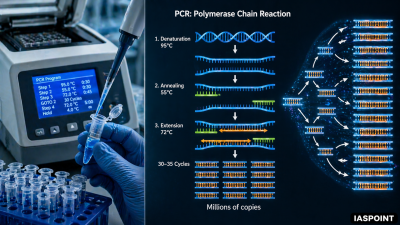
Polymerase Chain Reaction (PCR) is a revolutionary laboratory technique used to amplify a specific segment of DNA, generating millions of copies from a very small initial sample. Often referred to as “molecular photocopying,” it was developed by Kary Mullis in 1983, for which he received the Nobel Prize in Chemistry in 1993.
Core Components of PCR
To conduct a PCR reaction, five essential “ingredients” are required in a test tube (vial):
- Target DNA: The sample containing the specific segment to be amplified.
- Taq Polymerase: A thermostable DNA polymerase enzyme isolated from the bacterium Thermus aquaticus. It can withstand the high temperatures required for the process.
- Primers: Short, synthetic DNA sequences that provide a starting point for DNA synthesis.
- Nucleotides (dNTPs): The building blocks (A, T, G, C) used to synthesize new DNA strands.
- Buffer Solution: Maintains the optimal pH and chemical environment for the enzyme to function.
The Three-Step Cycle of PCR
The process takes place in a machine called a Thermal Cycler, which rapidly changes the temperature to facilitate three distinct stages.
1. Denaturation (94°C – 96°C)
The reaction mixture is heated to break the hydrogen bonds between the two strands of the DNA double helix, resulting in two single-stranded DNA templates.
2. Annealing (50°C – 65°C)
The temperature is lowered to allow the primers to bind (anneal) to their complementary sequences on the single-stranded DNA templates.
3. Extension/Elongation (72°C)
The temperature is raised slightly to the optimum working temperature of Taq polymerase. The enzyme adds nucleotides to the primers, synthesizing a new strand of DNA complementary to the template.
Note: This cycle is repeated 25–40 times. Since the DNA doubles with every cycle (2n copies), 30 cycles can produce over a billion copies of the target DNA.
Variants of PCR and Their Applications
| Variant | Full Form | Primary Use Case |
| RT-PCR | Reverse Transcription PCR | Used to detect RNA viruses (like SARS-CoV-2). It first converts RNA into cDNA. |
| qPCR | Quantitative PCR (Real-time) | Measures the DNA concentration in real-time during the amplification process. |
| Nested PCR | Nested PCR | Increases sensitivity and specificity by using two sets of primers in successive runs. |
| Multiplex PCR | Multiplex PCR | Amplifies multiple different DNA targets simultaneously in a single reaction. |
Key Applications in Biotechnology
- Medical Diagnostics: Detecting infectious agents (Bacteria, Viruses) and identifying genetic mutations associated with diseases like cancer or sickle cell anemia.
- Forensic Science: Amplifying DNA from minute traces found at crime scenes (blood, hair, skin) for DNA fingerprinting.
- Paleontology: Cloning DNA from ancient remains, such as mummies or extinct animals like the Woolly Mammoth.
- Pre-natal Diagnosis: Testing for genetic disorders in an embryo before birth.
- Environmental Monitoring: Detecting specific microbes in soil or water samples to track pollution or pathogens.
Fact Sheet and Trivia for UPSC Prelims
- Thermus aquaticus: This bacterium was originally discovered in the hot springs of Yellowstone National Park. Its ability to survive in extreme heat is why its polymerase (Taq) is used in PCR.
- RT-PCR vs. Real-Time PCR: While often confused, RT-PCR refers to the use of Reverse Transcriptase for RNA, whereas Real-Time PCR (qPCR) refers to the timing of the data collection.
- FELUDA Test: Developed by India’s CSIR-IGIB, this is a CRISPR-based diagnostic tool that is faster than traditional RT-PCR but provides similar accuracy for COVID-19 detection.
- Exponential Growth: PCR is an exponential process. If you start with 1 molecule of DNA, after 20 cycles you have 220 (approx. 1 million) copies.
- CT Value (Cycle Threshold): In COVID-19 testing, the CT value represents the number of cycles required for the viral signal to exceed the threshold. A lower CT value indicates a higher viral load.