

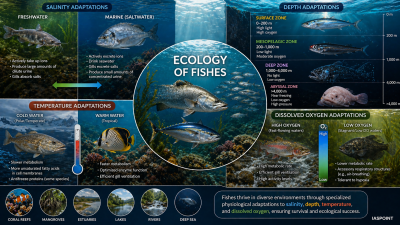
The ecology of fishes is defined by their physiological adaptations to salinity, depth, temperature, and dissolved oxygen.
1. Classification by Salinity Tolerance
Fishes are primarily categorized based on the salt concentration of their habitat and their physiological ability to handle fluctuations.
- Freshwater Fishes: Inhabit rivers, lakes, and streams (salinity < 0.5 ppt). They are typically hypertonic to their environment.
- Marine Fishes: Inhabit oceans and seas (salinity approx. 35 ppt). They are typically hypotonic to their environment.
- Brackish Water Fishes: Found in estuaries, mangroves, and lagoons where salt and fresh water mix.
- Stenohaline: Fishes that can tolerate only a narrow range of salinity (most strictly freshwater or marine species).
- Euryhaline: Fishes capable of adjusting to wide salinity variations (e.g., Salmon, Molly, Bull Shark).
2. Marine Ecology: Vertical Zonation
Marine habitats are divided into zones based on light penetration and depth, each hosting specialized fish communities.
| Zone | Depth | Characteristics | Common Fish Types |
| Epipelagic (Sunlight) | 0–200m | High light, high oxygen, abundant phytoplankton. | Tuna, Mackerel, Sharks, Flying fish. |
| Mesopelagic (Twilight) | 200–1000m | Dim light; thermocline (rapid temp drop) exists here. | Lanternfish (bioluminescent), Bristlemouths. |
| Bathypelagic (Midnight) | 1000–4000m | Perpetual darkness; high pressure; cold temperatures. | Anglerfish, Gulper Eel (large mouths). |
| Abyssal/Hadal | >4000m | Extreme pressure; near freezing; depends on “marine snow.” | Tripod fish, Snailfish. |
3. Ecological Adaptations to Specialized Habitats
Benthic vs. Pelagic Fishes
- Pelagic Fishes: Inhabit the upper layers of the open ocean. They are generally fast swimmers with streamlined bodies and counter-shading (darker top, lighter belly) for camouflage.
- Benthic Fishes: Live on or near the bottom. They are often dorso-ventrally flattened (e.g., Rays, Flounder) or have specialized camouflage to blend with the seabed.
Coral Reef Ecosystems
Coral reefs are the “Rainforests of the Sea.” Fishes in these habitats (e.g., Butterflyfish, Parrotfish, Clownfish) exhibit:
- Compressed bodies: To maneuver through tight reef crevices.
- Vibrant coloration: Used for territorial displays, mate recognition, or warning (aposematism).
Deep-Sea Adaptations
- Bioluminescence: Use of photophores to attract prey, find mates, or distract predators in the dark.
- Extreme Mouth Size: To consume any available prey, as food is scarce.
- Reduced Bone Mass: To withstand immense hydrostatic pressure.
4. Trophic Status and Food Web Role
Fishes occupy multiple levels in the aquatic food pyramid:
- Herbivores: Feed on algae and seagrass (e.g., Parrotfish). They prevent algal overgrowth on reefs.
- Plankton Feeders: Filter-feeders using gill rakers (e.g., Whale Shark, Herring).
- Carnivores/Predators: Feed on other fishes or invertebrates (e.g., Barracuda, Shark).
- Detritivores: Feed on decomposing organic matter at the bottom (e.g., Catfish).
5. Threats and Conservation Ecology
Understanding fish ecology is vital for addressing modern environmental challenges frequently mentioned in UPSC:
- Eutrophication: Nutrient runoff leads to algal blooms, depleting dissolved oxygen and creating “Dead Zones” where fish cannot survive.
- Coral Bleaching: Loss of symbiotic zooxanthellae affects the entire reef fish community.
- Overfishing: Removal of “Apex Predators” (like Sharks) causes a trophic cascade, disrupting the entire ecosystem balance.
- Invasive Species: Introduction of non-native species (e.g., Lionfish in the Atlantic or Tilapia in Indian wetlands) outcompetes indigenous species for resources.
UPSC Trivia: Ecological Records
- Gambusia affinis (Mosquito Fish): Used in Biological Control of mosquitoes; it eats mosquito larvae, helping prevent Malaria.
- Anadromous Migration and Dams: The Hilsa fish (Tenualosa ilisha) migration in India is severely impacted by the Farakka Barrage, illustrating the conflict between infrastructure and fish ecology.
- Benthos: Organisms living at the very bottom of a water body. Some fishes in this zone have lost their eyesight entirely, relying on chemoreceptors.