

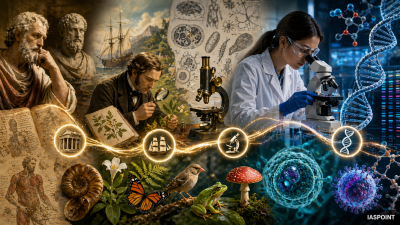
The history of biology is a transition from philosophical speculation to empirical observation and, finally, to molecular precision.
Ancient and Classical Foundations
Biological inquiry began with the systematic observation of nature in ancient civilizations, primarily focusing on medicinal plants and animal anatomy.
- Ancient India: The Ayurveda (c. 1500 BCE) categorized living beings into Jivaja (Viviparous), Andaja (Oviparous), Udbhija (Soil-born), and Svedaja (Heat/Moisture-born). Sushruta, known as the Father of Surgery, documented detailed human anatomy and surgical procedures in the Sushruta Samhita.
- Aristotle (384–322 BCE): Often cited as the Father of Biology, he was the first to classify animals based on their habitat (air, water, land) and the presence or absence of red blood (Enaima vs. Anaima).
- Theophrastus: A student of Aristotle, known as the Father of Botany, who classified over 500 plants in his work Enquiry into Plants.
The Renaissance and the Microscopic Revolution
The invention of the microscope in the 17th century transformed biology from a macroscopic study to a microscopic science, revealing the “unseen” world.
- Robert Hooke (1665): Observed thin slices of cork and coined the term “Cell” (Latin cella meaning small room) in his book Micrographia.
- Antonie van Leeuwenhoek (1674): The first to observe living cells, including bacteria, protozoa, and sperm cells, using high-quality single-lens microscopes.
- William Harvey (1628): Discovered the systemic circulation of blood, proving that the heart acts as a pump.
The Era of Taxonomy and Cell Theory
The 18th and 19th centuries provided the structural framework for organizing biological knowledge.
- Carl Linnaeus (1735): Established the Binomial Nomenclature system (Genus + Species) in his work Systema Naturae. He is regarded as the Father of Modern Taxonomy.
- Schleiden and Schwann (1838–39): Proposed the Cell Theory, stating that all plants and animals are composed of cells.
- Rudolf Virchow (1855): Expanded Cell Theory with the dictum Omnis cellula-e cellula, establishing that new cells arise only from the division of pre-existing cells.
The Darwinian Revolution and Genetics
The mid-19th century shifted the focus toward the origins and mechanisms of life’s diversity.
- Charles Darwin (1859): Published On the Origin of Species, introducing the theory of Evolution by Natural Selection.
- Gregor Mendel (1866): Conducted hybridization experiments on pea plants, formulating the Laws of Inheritance. His work remained unrecognized until its rediscovery in 1900 by Hugo de Vries, Carl Correns, and Erich von Tschermak.
- Louis Pasteur (1860s): Disproved the theory of “Spontaneous Generation” and established the Germ Theory of Disease, leading to the development of pasteurization and vaccines (Rabies, Anthrax).
Modern Biology: The Molecular Era
The 20th century focused on the chemical basis of life, leading to the birth of Biotechnology and Genomics.
| Year | Scientist(s) | Discovery/Contribution |
| 1928 | Alexander Fleming | Discovered Penicillin, the first true antibiotic, from the fungus Penicillium notatum. |
| 1944 | Avery, MacLeod, McCarty | Proved that DNA (not protein) is the hereditary material. |
| 1953 | Watson and Crick | Proposed the Double Helix model of DNA based on X-ray crystallography. |
| 1968 | Har Gobind Khorana | Deciphered the genetic code and synthesized the first artificial gene (Nobel Prize winner of Indian origin). |
| 1996 | Ian Wilmut | Created Dolly the Sheep, the first mammal cloned from an adult somatic cell. |
| 2003 | HGP Consortium | Completion of the Human Genome Project, mapping the entire human DNA sequence. |
Major Milestones in Indian Biology
- P.C. Ray: Though primarily a chemist, his work on indigenous drugs laid the foundation for pharmaceutical biology in India.
- M.S. Swaminathan: Leading figure in the Green Revolution, applying biological principles to crop improvement (Cytogenetics).
- Birbal Sahni: Known as the Father of Indian Paleobotany; researched the fossils of the Indian subcontinent.
- Janaki Ammal: Noted botanist who worked on cytogenetics and phytogeography, specifically improving sugarcane varieties.
Key Historical Concepts for Prelims
- Spontaneous Generation: The obsolete theory that living creatures could arise from non-living matter.
- Biogenesis: The principle that living matter arises only from other living matter.
- Lamarckism: The first theory of evolution (Inheritance of Acquired Characteristics), later largely superseded by Darwinism.
- Five Kingdom Classification: Introduced by R.H. Whittaker in 1969, replacing the older two-kingdom (Plant/Animal) system.