

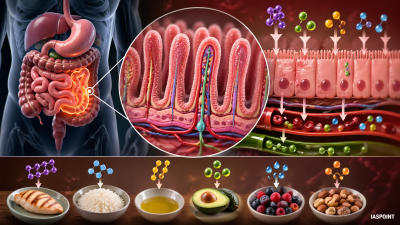
Absorption is the process by which the end products of digestion pass through the intestinal mucosa into the blood or lymph. While some absorption occurs in the mouth, stomach, and large intestine, the small intestine (specifically the jejunum and ileum) is the primary site for nutrient uptake due to the presence of villi and microvilli which increase the surface area.
Mechanisms of Absorption
Nutrients are absorbed via three main transport mechanisms depending on their chemical nature and concentration gradient:
- Simple Diffusion: Movement of molecules from higher to lower concentration (e.g., small amounts of glucose, amino acids, and electrolytes like chloride ions).
- Facilitated Transport: Movement aided by carrier proteins (e.g., glucose and some amino acids).
- Active Transport: Movement against a concentration gradient requiring energy in the form of ATP (e.g., various amino acids, monosaccharides like glucose, and electrolytes like Na^+).
Site-wise Absorption in the Alimentary Canal
| Organ | Substances Absorbed |
| Mouth | Certain drugs coming in contact with the mucosa of the mouth and lower side of the tongue. |
| Stomach | Water, simple sugars, and alcohol. |
| Small Intestine | Principal organ for absorption. Glucose, fructose, fatty acids, glycerol, and amino acids. |
| Large Intestine | Water, some minerals, and certain drugs. |
Absorption of Lipids (Fats)
Fatty acids and glycerol are water-insoluble and cannot be absorbed directly into the bloodstream. Their absorption involves a unique multi-step process:
- Micelles Formation: Fatty acids and glycerol are first incorporated into small, water-soluble droplets called micelles with the help of bile salts.
- Chylomicrons: Inside the intestinal mucosa cells, they are re-formed into very small protein-coated fat globules called chylomicrons.
- Lacteals: Chylomicrons are transported into the lymph vessels (lacteals) in the villi.
- Bloodstream: The lymph vessels eventually release the absorbed substances into the blood stream via the thoracic duct.
Role of the Large Intestine
While no significant digestive activity occurs here, the large intestine plays a critical role in maintaining fluid balance. It absorbs:
- Significant quantities of water.
- Minerals and certain electrolytes.
- Vitamins (specifically Vitamin K and B-complex) produced by symbiotic bacteria (e.g., E. coli) residing in the colon.
Assimilation and Egestion
- Assimilation: The process where absorbed substances reach the tissues which utilize them for energy, growth, and repair.
- Egestion: The elimination of undigested and unabsorbed substances (feces) through the anus. This is a voluntary process carried out by a mass peristaltic movement.
Important Facts for UPSC Prelims
- Hepatic Portal System: All nutrients absorbed from the digestive tract (except fats) are first carried to the liver via the hepatic portal vein before entering systemic circulation.
- Fructose Transport: Unlike glucose, which can be active or facilitated, fructose is primarily absorbed via facilitated diffusion using the GLUT5 transporter.
- Water Absorption: Approximately 90% of water absorption occurs in the small intestine through osmosis, following the osmotic gradient created by the absorption of solutes like Na^+.
- Vitamins: Fat-soluble vitamins (A, D, E, K) are absorbed along with lipids in micelles. Water-soluble vitamins (B, C) are absorbed by simple diffusion or specific transporters, except B12, which requires Intrinsic Factor from the stomach for absorption in the ileum.