

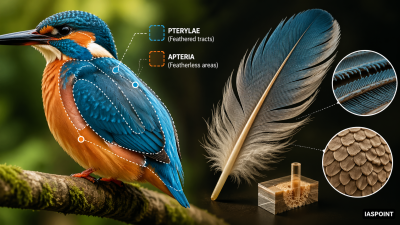
Feathers are the most identifying characteristic of Class Aves. They are complex branched structures made of Beta-keratin, a tough protein also found in reptilian scales. Feathers are not distributed uniformly over the bird’s body but grow in specific tracts called pterylae, while the featherless spaces are known as apteria.
Structural Anatomy of a Typical Feather
To understand feather types, one must first identify the basic structural components of a flight feather:
- Remiges/Rectrices: The broad, flat part of the feather.
- Calamus (Quill): The hollow, transparent base that attaches to the skin follicle.
- Rachis (Shaft): The central stiff axis that supports the vane.
- Barbs: Lateral branches extending from the rachis.
- Barbules and Hamuli: Microscopic filaments extending from barbs. The hamuli (hooks) interlock with adjacent barbules like a zipper, creating a continuous, airtight surface necessary for flight.
Classification of Feather Types
Birds possess different types of feathers, each specialized for a specific aerodynamic or physiological function.
| Feather Type | Structural Characteristics | Primary Function |
| Contour Feathers | Symmetrical; possess a well-developed vane with interlocking barbs. | Defines the bird’s streamlined shape and provides protection. |
| Flight Feathers | Asymmetrical; large and stiff. Includes Remiges (wings) and Rectrices (tail). | Provides lift and enables steering/braking during flight. |
| Down Feathers | Short rachis or absent; barbs are long and fluffy without hooks (hamuli). | Thermal insulation by trapping a layer of air next to the skin. |
| Filoplumes | Hair-like with a long rachis and a small tuft of barbs at the tip. | Sensory function; they help birds monitor the position of flight feathers. |
| Bristles | Stiff rachis with few or no barbs at the base. | Found around the mouth (rictal bristles) or eyes for protection or capturing insects. |
| Powder Down | Feathers that never molt; they disintegrate into a fine keratin powder. | Waterproofing and cleaning; common in Herons and Parrots. |
Physiological and Evolutionary Significance
1. Thermoregulation (Endothermy)
Feathers are among the most efficient natural insulators. By fluffing their feathers, birds increase the thickness of the trapped air layer, reducing heat loss in cold environments. Conversely, flattening feathers helps dissipate heat.
2. Water Repellency
While the structure of the feather itself provides some resistance, birds apply oil from the Uropygial gland (Preen gland) using their beaks. This oil maintains the flexibility of the keratin and enhances the waterproof barrier, crucial for aquatic species like ducks.
3. Aerodynamics and Camouflage
- Lift and Thrust: The asymmetrical shape of flight feathers creates a pressure differential (Bernoulli’s principle) allowing for lift.
- Crypsis: Feather pigments (melanins, carotenoids) and structural colors provide camouflage to evade predators.
Important Facts for UPSC Prelims
- Molt (Ecdysis): The process of replacing old, worn-out feathers with new ones. This is usually timed with seasonal changes or reproductive cycles to ensure maximum flight efficiency.
- Preening: A behavioral adaptation where birds use their beaks to re-zip the barbules and spread preen oil.
- Flightless Birds: In Ratites (e.g., Ostrich), the feathers lack the interlocking hamuli, resulting in a “shaggy” or hair-like appearance since they do not need to create an airtight wing surface.
- Coloration: Pink colors in Flamingos are not genetic; they are acquired by consuming carotenoid-rich brine shrimp and blue-green algae.
Comparison: Down vs. Contour Feathers
| Feature | Down Feathers | Contour Feathers |
| Rachis | Reduced or absent. | Long and prominent. |
| Hooks (Hamuli) | Absent (Barbs stay loose). | Present (Barbs interlock). |
| Location | Beneath contour feathers. | External surface of the body. |
| Main Use | Heat retention. | Flight and shape. |