

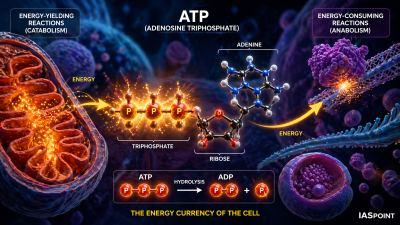
Adenosine Triphosphate (ATP) is a complex organic chemical that provides energy to drive many processes in living cells. Often referred to as the “Energy Currency of the Cell,” it acts as a molecular bridge between energy-yielding reactions (catabolism) and energy-consuming reactions (anabolism).
Chemical Structure of ATP
ATP is technically a nucleotide, similar to the building blocks of RNA, but it contains three phosphate groups instead of one. It is composed of three components:
- Nitrogenous Base: Adenine (a purine).
- Pentose Sugar: Ribose.
- Phosphate Groups: Three phosphate groups linked in a series (α, β, and γ phosphates).
The bonds between the phosphate groups are known as phosphoanhydride bonds. These are high-energy bonds because the negatively charged phosphate groups repel each other, creating a “coiled spring” effect of potential energy.
Mechanism of Energy Release
Energy is released from ATP through a process called Hydrolysis, where a water molecule is used to break a phosphate bond.
- ATP to ADP: When the terminal (γ) phosphate bond is broken, ATP is converted into Adenosine Diphosphate (ADP) and an inorganic phosphate (Pi). This reaction releases approximately 7.3 kcal/mol (or 30.5 kJ/mol) of energy under standard conditions.
- ADP to AMP: Further hydrolysis can convert ADP into Adenosine Monophosphate (AMP), releasing additional energy, though this is less common in standard metabolic tasks.
- Reversibility: The reaction is reversible. Cells use energy from the oxidation of food (respiration) to re-attach a phosphate group to ADP, a process called Phosphorylation.
Role in Cellular Metabolism
ATP is involved in three main types of cellular work:
- Chemical Work: Providing the energy needed to synthesize macromolecules like proteins, lipids, and nucleic acids.
- Transport Work: Pumping substances across cell membranes against their concentration gradient (e.g., the Sodium-Potassium Pump).
- Mechanical Work: Powering physical movement, such as the contraction of muscle fibers (Actin and Myosin interaction) and the movement of cilia or flagella.
Synthesis of ATP: Phosphorylation
Cells generate ATP through three primary pathways:
| Pathway | Description | Occurrence |
| Substrate-Level Phosphorylation | Direct transfer of a phosphate group to ADP from a metabolic intermediate. | Glycolysis and Krebs Cycle. |
| Oxidative Phosphorylation | Production of ATP using energy derived from the Electron Transport Chain (ETC). | Mitochondria (Inner membrane/Cristae). |
| Photophosphorylation | Use of light energy to convert ADP to ATP. | Chloroplasts (Thylakoids) during Photosynthesis. |
Comparative Energy Storage
- ATP vs. Glucose: While ATP is the immediate source of energy, it is not a good long-term storage molecule because it is unstable. A single molecule of Glucose contains about 30 to 32 times the potential energy of one ATP molecule. Therefore, cells store energy as carbohydrates (starch/glycogen) or fats and convert them into ATP only as needed.
- ATP Turnover: The human body does not store a large amount of ATP. Instead, it is constantly recycled. An average human cell consumes and regenerates its entire stock of ATP every 1–2 minutes.
UPSC Prelims Fact File
- Mitochondria: Known as the “Powerhouse of the cell” because they are the primary site for oxidative phosphorylation, producing the bulk of the cell’s ATP.
- Proton Gradient: In mitochondria and chloroplasts, ATP synthesis is driven by a “proton motive force” where H^+ ions flow through a protein complex called ATP Synthase (the F0-F1 particle).
- ATP as a Signaling Molecule: Beyond energy, ATP acts as a neurotransmitter in the central and peripheral nervous systems.
- Cyanide Poisoning: Cyanide is lethal because it inhibits the enzyme Cytochrome c Oxidase in the Electron Transport Chain, effectively halting ATP production and causing cellular “starvation.”
- Bioluminescence: In organisms like fireflies, the enzyme Luciferase uses the energy from ATP hydrolysis to produce light.