

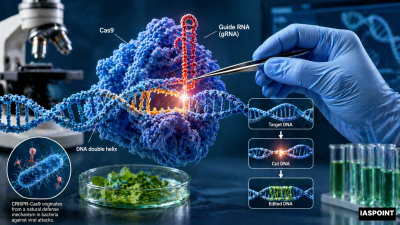
CRISPR-Cas9 (Clustered Regularly Interspaced Short Palindromic Repeats and Associated Protein 9) is a groundbreaking gene-editing tool that allows scientists to modify, add, or remove specific sections of DNA with high precision. Originating from a natural defense mechanism in bacteria against viral attacks, it is often described as “genetic scissors.”
Mechanism of Action
The CRISPR-Cas9 system consists of two primary components that work together to edit the genome:
- Guide RNA (gRNA): A small piece of pre-designed RNA sequence that is complementary to the target DNA. It acts as a GPS, guiding the system to the exact location on the genome.
- Cas9 Enzyme: A protein that acts as the “scissors.” Once the gRNA identifies the target sequence, Cas9 cuts the DNA strands at that specific location.
- DNA Repair: Once the DNA is cut, the cell’s natural repair mechanisms kick in. Scientists can leverage this phase to either disable a gene or insert a new, functional DNA sequence.
Applications in Agriculture and Food Security
CRISPR technology is revolutionizing plant breeding by offering faster and more precise alternatives to traditional GMO methods.
- Biofortification: Enhancing the nutritional value of crops, such as developing “Golden Rice” or bananas with increased Vitamin A.
- Climate Resilience: Engineering crops to withstand extreme weather conditions, including drought-tolerant wheat and salt-tolerant rice varieties.
- Pest and Disease Resistance: Creating varieties like mildew-resistant grapes or blight-resistant potatoes without the use of foreign bacterial DNA (unlike traditional Bt technology).
- Shelf-life Extension: Reducing food waste by silencing genes responsible for browning in mushrooms and apples.
Medical and Therapeutic Applications
CRISPR holds the potential to treat and cure genetic disorders that were previously considered incurable.
- Monogenic Disorders: Targeting diseases caused by a single gene mutation, such as Sickle Cell Anemia, Thalassemia, and Cystic Fibrosis.
- Cancer Immunotherapy: Modifying T-cells (CAR-T therapy) to better recognize and destroy cancer cells.
- Viral Infections: Research is ongoing to use CRISPR to “snip out” viral DNA from infected human cells in diseases like HIV and Hepatitis B.
- Xenotransplantation: Editing the genomes of pigs to make their organs compatible for human transplantation by removing porcine endogenous retroviruses (PERVs).
Comparative Analysis: CRISPR vs. Traditional GMOs
| Feature | Traditional GMO (Transgenic) | CRISPR (Gene Edited) |
| Source of DNA | Often involves foreign DNA (e.g., from bacteria). | Often involves no foreign DNA (SDN-1/SDN-2). |
| Precision | Insertion is somewhat random in the genome. | Extremely precise targeting of specific loci. |
| Regulation in India | Strict regulation under GEAC. | SDN-1 and SDN-2 categories are exempted from GEAC. |
| Timeframe | Takes years to stabilize a transgenic line. | Significantly faster development cycle. |
Regulatory Landscape in India
India has adopted a progressive stance toward gene editing, distinguishing it from traditional GMOs based on the level of modification.
- Exemption of SDN-1 and SDN-2: In 2022, the Ministry of Environment, Forest and Climate Change exempted Site-Directed Nucleogenesis (SDN) 1 and 2 from the stringent GEAC approval process required for GMOs.
- SDN-1: Small deletions or insertions without foreign DNA.
- SDN-2: Minor edits using a template but without foreign DNA.
- SDN-3: Involves the insertion of larger foreign DNA sequences (still regulated as GMOs).
Ethical and Biosafety Concerns
Despite its benefits, CRISPR technology raises significant ethical and safety questions.
- Off-target Effects: The risk of the Cas9 enzyme cutting DNA at locations other than the intended target, potentially causing unintended mutations or cancers.
- Germline Editing: Changes made to human embryos (germline) are heritable, leading to concerns over “designer babies” and permanent changes to the human gene pool.
- Gene Drives: Using CRISPR to ensure a specific trait is passed to all offspring in a wild population (e.g., mosquito sterilization), which could lead to unforeseen ecological collapses.
Fact Sheet and Trivia for UPSC Prelims
- Nobel Prize: Emmanuelle Charpentier and Jennifer A. Doudna were awarded the 2020 Nobel Prize in Chemistry for the development of the CRISPR-Cas9 method for genome editing.
- Natural Origin: CRISPR was first discovered as an adaptive immune system in bacteria like Streptococcus pyogenes.
- Cas-12 and Cas-13: While Cas9 is the most famous, other proteins like Cas-12 (for DNA) and Cas-13 (for RNA) are being developed for diagnostic tools like FELUDA (developed by CSIR-IGIB, India).
- First CRISPR Therapy: In 2023, the UK and US regulators approved Casgevy, the world’s first CRISPR-based gene-editing treatment for Sickle Cell Disease and Thalassemia.