

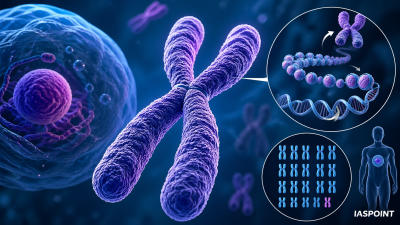
Chromosomes are highly condensed, thread-like structures composed of DNA and proteins (chromatin) that carry the genetic information of an organism. They become visible under a light microscope only during the stages of cell division (Mitosis and Meiosis). In humans, each cell typically contains 23 pairs of chromosomes, totaling 46.
Structural Components of a Chromosome
A typical metaphase chromosome consists of two identical halves called sister chromatids, joined at a specific point.
- Chromatids: The two longitudinal halves of a duplicated chromosome. They contain identical DNA molecules.
- Centromere (Primary Constriction): The region where the two sister chromatids are held together. It is essential for the attachment of spindle fibers.
- Kinetochore: A disc-shaped protein complex on the surface of the centromere to which spindle fibers attach during cell division.
- Telomeres: The specialized DNA sequences at the tips of the chromosomal arms. They prevent the ends of the chromosome from fraying or sticking to each other and play a role in cellular aging.
- Secondary Constriction & Satellite: Some chromosomes have a secondary constriction that marks the site of the Nucleolar Organizer Region (NOR). The small fragment beyond this constriction is called a Satellite.
Classification Based on Centromere Position
The position of the centromere determines the shape of the chromosome during the anaphase of cell division.
| Type | Centromere Position | Shape during Anaphase |
|---|---|---|
| Metacentric | Middle (equal arms) | V-shaped |
| Sub-metacentric | Slightly away from the middle | L-shaped |
| Acrocentric | Near the end (one very short arm) | J-shaped |
| Telocentric | At the very tip | I-shaped |
Types of Chromosomes in Humans
- Autosomes: These are the first 22 pairs of chromosomes that determine somatic traits (body characteristics) and are identical in both males and females.
- Allosomes (Sex Chromosomes): The 23rd pair (XX in females, XY in males) which determines the biological sex of the individual.
Specialized “Giant” Chromosomes
In certain organisms and tissues, specialized chromosomes exist that are much larger than standard chromosomes:
- Polytene Chromosomes: Found in the salivary glands of insects (e.g., Drosophila). They are formed by repeated DNA replication without cell division.
- Lampbrush Chromosomes: Found in the oocytes (developing eggs) of amphibians and birds. They have large loops of DNA that are actively being transcribed into RNA.
Clinical and Genetic Importance
- Karyotype: A standard photograph or chart of an individual’s chromosomes arranged in pairs. It is used to detect chromosomal abnormalities.
- Aneuploidy: An abnormal number of chromosomes. Examples include:
- Down Syndrome: Trisomy of chromosome 21 (47 chromosomes).
- Klinefelter Syndrome: An extra X chromosome in males (47, XXY).
- Turner Syndrome: A missing X chromosome in females (45, X).
Facts for UPSC Prelims
- Ploidy: Humans are diploid (2n=46), meaning we have two sets of chromosomes. Gametes (sperm and egg) are haploid (n=23).
- DNA to Chromosome Ratio: A single chromosome in the unreplicated state contains exactly one continuous molecule of double-stranded DNA.
- Staining: Chromosomes are typically stained with Giemsa stain (G-banding) to reveal patterns of light and dark bands used for identification.
- Non-disjunction: The failure of sister chromatids or homologous chromosomes to separate properly during cell division is the primary cause of chromosomal disorders.
- Telomerase: An enzyme that maintains the length of telomeres. High activity of telomerase is often seen in cancer cells, making them “immortal.”