

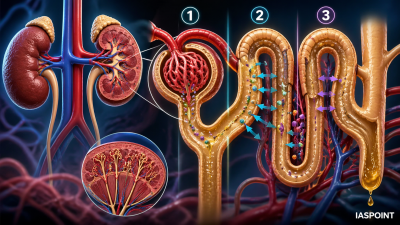
Urine formation is a sophisticated process designed to clear metabolic waste from the blood while strictly regulating water and electrolyte balance. This process occurs within the nephrons and involves three distinct physiological stages: Glomerular Filtration, Reabsorption, and Secretion.
1. Glomerular Filtration (Ultrafiltration)
This is the first step of urine formation, occurring in the renal corpuscle (Malpighian body).
- Pressure-Driven Process: Blood enters the glomerulus through the wide afferent arteriole and leaves via the narrower efferent arteriole. This creates high hydrostatic pressure, forcing fluids out of the capillaries.
- The Filtration Membrane: The blood is filtered through three layers:
- The endothelium of glomerular blood vessels.
- The epithelium of Bowman’s capsule (containing specialized cells called podocytes).
- The basement membrane between these two layers.
- Filtration Slits: Podocytes are arranged in an intricate manner to leave minute spaces called filtration slits or slit pores.
- The Filtrate: Almost all constituents of the plasma pass into the lumen of the Bowman’s capsule, except for proteins and blood cells. Hence, it is termed Ultrafiltration.
2. Selective Reabsorption
A massive volume of filtrate (approx. 180 liters/day) is produced, but only about 1.5 liters is excreted as urine. This means 99% of the filtrate is reabsorbed by the renal tubules.
- Proximal Convoluted Tubule (PCT): This is the main site of reabsorption. Nearly all essential nutrients (glucose, amino acids) and 70-80% of electrolytes and water are reabsorbed here.
- Loop of Henle:
- Descending Limb: Permeable to water but almost impermeable to electrolytes. This concentrates the filtrate.
- Ascending Limb: Impermeable to water but allows transport of electrolytes (active or passive). This dilutes the filtrate as it moves upward.
- Distal Convoluted Tubule (DCT): Conditional reabsorption of Na^+ and water takes place here, largely regulated by hormones like Aldosterone.
3. Tubular Secretion
During filtrate movement, the tubular cells secrete additional waste substances into the filtrate.
- Substances Secreted: H^+, K^+, and ammonia (NH3).
- Significance: This step is vital for the maintenance of ionic balance and the acid-base (pH) balance of body fluids.
Summary Table: Tubular Function by Segment
| Segment | Reabsorption | Secretion | Resulting Filtrate |
| PCT | Glucose, Amino Acids, Na^+, H2O, HCO3^- | H^+, Ammonia, K^+ | Isotonic to plasma |
| Loop of Henle (Desc) | Water | Minimal | Hypertonic (Concentrated) |
| Loop of Henle (Asc) | Na^+, Cl^- | Minimal | Hypotonic (Diluted) |
| DCT | Na^+, H2O, HCO3^- | K^+, H^+ | Fine-tuned osmolarity |
| Collecting Duct | Large amounts of Water | K^+, H^+ | Concentrated Urine |
Hormonal Regulation of Urine Formation
The volume and concentration of urine are dynamically regulated based on the body’s hydration status.
- Antidiuretic Hormone (ADH/Vasopressin): Released by the posterior pituitary when osmoreceptors detect low blood volume. It makes the DCT and collecting ducts more permeable to water, reducing urine volume (Antidiuresis).
- Renin-Angiotensin-Aldosterone System (RAAS): Triggered by a fall in glomerular blood pressure. Renin (from the JGA) eventually leads to the release of Aldosterone, which increases Na^+ and water reabsorption.
- Atrial Natriuretic Factor (ANF): Released by the heart’s atrial walls in response to high blood pressure. It causes vasodilation and acts as a check on the RAAS to increase salt and water excretion.
UPSC Prelims Facts and Trivia
- Glomerular Filtration Rate (GFR): The amount of filtrate formed by the kidneys per minute. Normal GFR is 125 ml/min.
- Juxtaglomerular Apparatus (JGA): A specialized microscopic structure that regulates GFR and blood pressure.
- Osmolarity Gradient: The kidney maintains a gradient from 300 mOsmol/L in the cortex to 1200 mOsmol/L in the inner medulla, enabling the production of concentrated urine.
- Urine Character: Healthy urine is slightly acidic (pH approx. 6.0) and has a characteristic odor due to the presence of urinod.
- Daily Urea Excretion: On average, 25-30 grams of urea is excreted per day.