
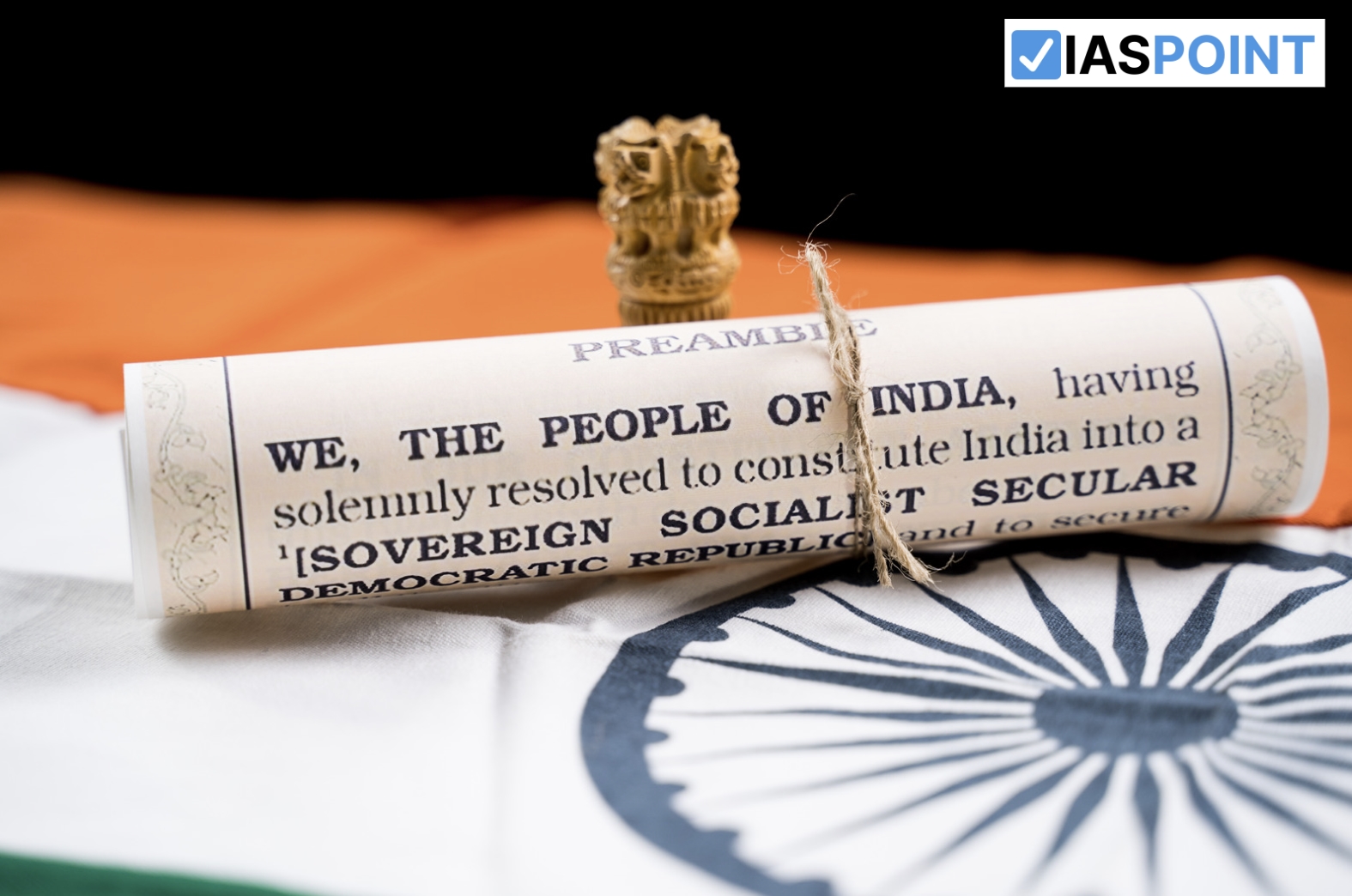

The Constitution, implicitly, provides for a secular state, allowing its people to profess, practise and propagate the religion of their choice and manage their religious affairs. The Constitution does not allow any person to pay any such tax the proceeds of which would be spent on any particular religion and that the state would not discriminate while giving grants to cultural and educational institutions, specifying clearly that no religious instructions would be imparted in such institutions. It is, thus, clear that the State, on its own, would not favour or patronize any particular religion. Unlike the Western concept of secularism which is based on the separation of religion and politics, the Indian state admits the fusion of religion and politics with equal respect for all the religions alike, and regards religion as purely a private air of the individual. The fact of the matter is that the Indian State is not a Godless state in so far as its including the President of India, take oath of the their either swearing in the name of God or making a solemn nation.
Basic Structure of the Constitution:
A novel but an important feature that has evolved, of late, is the concept of basic structure of the Constitution. Too many amendments, (around 98 till August, 2014 over a period of over 60 years) have threatened the very face of the Constitution. With the politicians in their zeal to bring about socio-economic changes in the polity, the Constitution, and in particular, its basic essentials came under the risk of being defaced and diffused. The Courts, especially the Supreme Court, took upon themselves to keep the Constitutions basic essentials beyond the reach of the legislatures’ hasty legislations. rough numerous decisions beginning with the Kesavananda Bharati’s case, the Supreme Court, supported by the concepts of judicial review and of judicial activism, has indicated a domain (in the form of the basic structure of the Constitution) which is out of reach of the Parliament, and a resolve of the courts to challenge and even outlaw the laws and the amendments made that contravene the basic structure of the Constitution.
Rural’Urban Institutions :
A third level of administration, in the form of Panchayati Raj and urban institutions, has been added to our federal structure with already two earlier levels’the Union Government and the States and ‘Union Territories’ Governments. Part IX of the Constitution deals with the Panchayati Raj, with Schedule Eleven assigning legislative powers to rural administrative bodies, Part IXA of the Constitution deals with the Municipalities along with Twelfth Schedule assigning legislative powers to the urban administrative institutions. These changes have been made through 73rd and 74th amendments (1993) of the Constitution.
Universal Adult Franchise and Joint Electorates:
As against the separate electorates provisions, during the British days (which helped promote communalization in the country), the independent India decided to opt for universal adult franchise declaring every citizen of 18 years and above (61st amendment, 1989) as one having the franchise right (Article 326). There is also a provision of joint electorates wherein a particular constituency, the voters belong to all who are registered as voters but the concerned seat of the constituency is reserved for a particular section of society. 15% seats in the Parliament, the State Legislative Assemblies, urban and rural local bodies are reserved for the Scheduled Castes and 7.5% of seats for the Scheduled Tribes (Article 330). There is also a provision for one-third reservation of seats for women as well as for the scheduled castes/tribes in rural-urban bodies (73rd and 74th amendment of 1993). The Constitution provides for the nomination of two persons belonging to the Anglo-Indian community in the Lok Sabha if the President is satisfied that the said community has not been adequately represented in the Lok Sabha (Article 331). Such a reservation (one member only) for the Anglo-Indian community has been provided in the states of Andhra Pradesh, Tamil Nadu, Bihar, Karnataka, and Kerala (Article 333).
Special Provisions relating to certain Classes:
Part XVI of the Constitution provides for special provisions relating to certain sections, particularly in respect of the weaker sections of society like the Scheduled Castes and the Scheduled Tribes granting them reservation in the legislatures, services and special facilities in education (Articles 330, 331, 335). There is also a provision for a commission to investigate the conditions of socially and educationally backward classes so to recommend for their welfare (Articles 340). The interests of the cultural and religious minorities have been ensured by Articles 29 and 30 of the Constitution.
Integrated Judiciary and Single Citizenship:
Despite the fact that the Constitution provides for a federal structure, our judicial system is not federal, nor is our citizenship, plural. e Supreme Court supervises the functioning of the High Courts, is consulted in the appointment of the High Court judges (Article 217), hears appeals against the decisions of the High Courts (Articles 132, 133, 134), grants special leave to appeal (Article 137). The citizenship, in India, is singular, i .e. every citizen is a citizen of India (Article 5).
Hindi as the Official Language:
Article 343 of the Constitution declares Hindi, is (in Devanagari script), the official language of the country. e individual states can legislate for their own official languages. For example, the state of Karnataka has Kannada as its sole official language, the state of Maharashtra has Marathi while the state of Punjab, Panjabi, and the state of Odisha, Odia and Kerala, Malayalam, and Jammu and Kashmir, Kashmiri, Urdu and Dogri languages as their official languages. Besides, Tamil, Sanskrit, Kannada and Telugu have been declared as the classical languages by the Government of India in 2004, 2005, and 2008 respectively.
The above features make the Constitution really a unique one. What is more, and that is once again, a novelty of our Constitution is that it is the supreme law of our land. is makes neither the Union Government nor the governments of the States as supreme but it is the Constitution itself which, because of its supremacy, makes everything else, subordinate to it. The President has to protect its sanctity. Though it has become too lengthy in size, yet it has emerged as an instrument of both stability and adaptability.
Indeed, it has to its credit both the substantive and the procedural achievements. Rajiv Bhargava (Politics and Ethics of the Indian Constitution) counts the substantive achievements to include : (1) universal surage in the face of ineliminable traditional hierarchies, (ii) liberal individualism in the context of communitarian values, (iii) a commitment to group rights related to cultural minorities, (iv) caste-based armative action schemes granted to the depressed sections, and (v) a federal structure asymmetrical in nature. The procedural achievements, according to Bhargava, have been: (i) a faith in political deliberations, (ii) the spirit of compromise and accommodation, and (iii) consensually reached decisions. e drawbacks do not escape the attention of Bhargava which, according to him, include: (a) the Constitution is unwieldy, for it contains everything under the sky; (b) largely unrepresentative constituent assembly, for its composition was based on electorate which represented hardly more than 15% of the population; (c) the Constitution was more or less ambigious at places, and (d) an alien document, for it had been ordered by a Constituent Assembly established by the British.


