
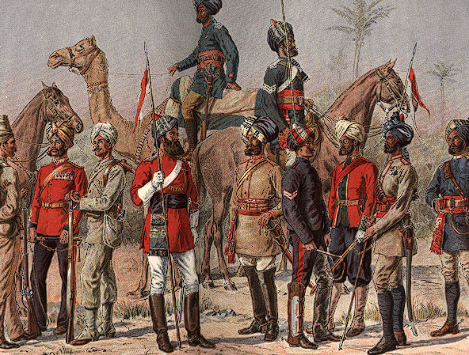
Charles Canning, 1st Earl Canning, served as the Governor-General of India from 1856 to 1858 and, following the structural reorganization of the empire, became the first Viceroy of India from 1858 to 1862. His administration constitutes the most critical hinge point in modern Indian history, spanning the violent collapse of the East India Company’s rule and the formal establishment of the British Raj under the direct sovereign authority of the British Crown.
The Revolt of 1857 and Military Stabilization
The early part of Lord Canning’s tenure was dominated by the outbreak of the Revolt of 1857 (the Sepoy Mutiny). His response to the crisis combined strategic military mobilization with a deliberate political strategy of postwar moderation.
Outbreak and Suppression
- Immediate Trigger: The introduction of the Enfield rifle with greased cartridges sparked open mutiny at Meerut on May 10, 1857, quickly spreading across Awadh, Delhi, and Central India.
- Military Mobilization: Canning redirected British troops en route to China to the Indian theater and successfully secured the neutrality of the Punjabi and Gurkha regiments to suppress the uprising.
Clemency Policy
- The “Clemency Canning” Decree: In July 1857, Canning issued an administrative resolution urging judicial restraint and distinguishing between active ringleaders and sepoys who mutinied under peer pressure. This policy of moderation drew fierce opposition from the Anglo-Indian press but prevented further protracted guerrilla resistance.
Constitutional and Administrative Transitions
Government of India Act 1858
The structural consequence of the 1857 revolt was the passage of the Government of India Act 1858, which legally dismantled the East India Company.
- Dual Governance Dissolved: The Act abolished the Board of Control and the Court of Directors.
- Crown Takeover: Imperial authority was transferred directly to the British Crown, exercised via the newly created cabinet post of the Secretary of State for India and an advisory 15-member Council of India.
- Designation of Viceroy: The Governor-General was elevated to the status of Viceroy when acting as the direct representative of the monarch to the princely states.
Queen’s Proclamation (1858)
On November 1, 1858, Lord Canning read Queen Victoria’s Proclamation at a grand Durbar in Allahabad. The declaration formally abandoned Lord Dalhousie’s aggressive “Doctrine of Lapse,” guaranteed the territorial integrity of native princely states, promised non-interference in indigenous socio-religious customs, and granted a general amnesty to all rebels not directly involved in the murder of British subjects.
Indian Councils Act 1861
Canning was instrumental in shaping the Indian Councils Act 1861, which laid the foundational blueprint for the modern institutional framework of governance in India.
- Introduction of the Portfolio System: Canning decentralized executive work by assigning specific administrative departments (such as Foreign Affairs, Home, Finance, and Military) to individual members of the Executive Council, creating the precursor to the modern Cabinet system.
- Expansion of Legislative Councils: The Act expanded the Viceroy’s Executive Council for legislative purposes by adding non-official members, facilitating the institutional entry of Indians into the lawmaking process. Three Indians were subsequently nominated: Raja Sir Deo Narayan Singh of Benaras, Maharaja Narendra Singh of Patiala, and Sir Dinkar Rao of Gwalior.
- Ordinance-Making Power: The Act granted the Viceroy the executive authority to issue emergency ordinances with a maximum validity of six months without the prior concurrence of the Legislative Council.
Judicial and Legal Structural Changes
Indian High Courts Act 1861
This statute authorized the amalgamation of the old Supreme Courts and the native Adalats (Sadr Diwani Adalat and Sadr Nizamat Adalat). This consolidation led to the formal establishment of the High Courts of Calcutta, Bombay, and Madras in 1862, unifying the judicial system across the Presidencies.
Codification of Uniform Penal Laws
Canning oversaw the structural codification of Indian jurisprudence, replacing fragmented regional legal systems with standardized statutory codes based on the recommendations of the First Law Commission.
- Indian Penal Code (IPC): Drafted originally by Lord Macaulay in 1837, the IPC was enacted into law in 1860 and went into formal operation on January 1, 1862.
- Code of Criminal Procedure (CrPC): Enacted in 1861 to standardize criminal prosecution procedures across all British territories.
Financial and Economic Overhaul
The fiscal strain of suppressing the 1857 revolt left the Government of India facing a massive budgetary deficit. To restructure the empire’s finances, Canning appointed Britain’s preeminent economist, James Wilson, as India’s first Financial Member of the Council in 1859.
Introduction of Modern Taxation
- Income Tax: Act XXXII of 1860 introduced India’s first uniform Income Tax, levying a 4% tax on all annual incomes exceeding 500 rupees to stabilize state finances.
- Uniform Paper Currency: The Paper Currency Act of 1861 granted the state a monopoly over note issue, establishing a uniform national paper currency backed by a gold and silver reserve system.
- Customs Duties: Standardized import tariffs were introduced, establishing a 10% uniform tariff on imported manufactured goods.
Socio-Educational and Land Reforms
Foundation of Presidency Universities (1857)
Following the educational blueprint laid down by Charles Wood’s Despatch of 1854, Canning approved the formal incorporation of India’s first modern Western universities in 1857. The University of Calcutta, the University of Bombay, and the University of Madras were established on the organizational model of the University of London.
Bengal Rent Act 1859 (Act X of 1859)
To mitigate widespread rural unrest caused by the exploitation of cultivators by Zamindars, Canning passed the Bengal Rent Act of 1859. This legislation provided the first legal security of tenure to native ryots, granting occupancy rights to any tenant who could prove continuous cultivation of a plot of land for a minimum uninterrupted period of 12 years.
Indigo Revolt (1859–1860)
The aggressive economic exploitation by European planters sparked the Indigo Revolt (Nil Vidroha) across Bengal, led by Digambar Biswas and Bishnucharan Biswas. In response to the widespread strike by ryots, Canning appointed the Indigo Commission in 1860 under W.S. Seton-Karr, which legally declared that cultivators could not be physically compelled to grow indigo against their will.
Detailed Administrative and Historical Timeline
| Year | Historical Legislation / Event | Immediate Administrative and Structural Impact |
| 1856 | General Service Enlistment Act | Mandated overseas deployment for Bengal Army recruits, sparking caste grievances. |
| 1856 | Hindu Widows’ Remarriage Act | Passed into law immediately after his arrival, validating widow remarriages. |
| 1857 | Outbreak of the Revolt of 1857 | Sparked by mutiny at Meerut; led to temporary loss of central British control. |
| 1857 | Incorporation of Presidency Universities | Established the foundational universities of Calcutta, Bombay, and Madras. |
| 1858 | Government of India Act 1858 | Liquidated the East India Company; transferred direct rule to the Crown. |
| 1858 | Reading of the Queen’s Proclamation | Read at Allahabad Durbar; officially renounced the Doctrine of Lapse. |
| 1859 | Appointment of James Wilson | Formalized the modern budgetary process and introduced fiscal reforms. |
| 1859 | Bengal Rent Act Passed | Granted legal occupancy rights to long-term tenant cultivators. |
| 1860 | Introduction of Income Tax | Imposed India’s first structural direct tax to remedy wartime deficit. |
| 1860 | Enactment of the Indian Penal Code | Uniform codification of substantive criminal law across British India. |
| 1861 | Indian Councils Act 1861 | Introduced the Portfolio system and inducted non-official Indian members. |
| 1861 | Indian High Courts Act | Authorized the creation of uniform High Courts in the three Presidencies. |
| 1861 | Paper Currency Act | Decentralized currency notes printing; established state monopoly on paper money. |
| 1861 | Archaeological Survey of India (ASI) | Founded by Canning with Alexander Cunningham appointed as first Surveyor. |
Analytical Assessment and Prelims Trivia
Creation of the Archaeological Survey of India (1861)
Lord Canning took a keen interest in preserving historical monuments and institutionalized archeology by creating the Archaeological Survey of India (ASI) in 1861. He appointed Alexander Cunningham as the first Archaeological Surveyor, initiating the systematic excavation, mapping, and conservation of ancient Indian structures.
White Mutiny (1859)
Following the transfer of power from the Company to the Crown under the 1858 Act, European troops previously employed by the East India Company staged an institutional strike known as the “White Mutiny.” They objected to being transferred to the Queen’s army without a fresh enlistment bounty. Canning defused the crisis by offering free discharges and passage home to those soldiers who refused Crown enlistment.
Structural Rebalancing of the Military
Based on the recommendations of the Peel Commission (1859), Canning oversaw the complete restructuring of the military apparatus to prevent future mutinies. The ratio of European to native soldiers was fixed at 1:2 in the Bengal Army and 1:3 in the Madras and Bombay Armies. Crucially, all strategic branches, particularly the heavy artillery, were placed exclusively under European control.
Last Modified: June 13, 2026