
The structural impact of the Revolt of 1857 extended far beyond the immediate constitutional shifts of 1858. It left a profound socio-political, psychological, and institutional legacy that fundamentally altered the relationship between the British colonizers and the Indian subjects. This legacy shaped the trajectory of administrative policies, communal relations, and the conceptual evolution of modern Indian nationalism for the next nine decades.
Institutional and Administrative Legacies
The post-1857 era witnessed a complete abandonment of aggressive modernizing reforms in favor of conservative political consolidation.
1. Alliance with Feudal and Reactionary Elements
Prior to 1857, British administrators like Lord Dalhousie sought to dismantle the traditional feudal structures of India through policies like the Doctrine of Lapse. The revolt forced a complete reversal of this strategy.
- The New Policy: Recognizing that the princely states and wealthy zamindars had acted as “breakwaters” during the rebellion, the British decided to preserve and champion these traditional elites.
- The Outcome: The British Crown guaranteed the perpetuity of princely states and shielded them from internal democratic pressures. This turned the native princes, taluqdars, and big landlords into the most loyal, conservative pillars of British imperialism in India, deliberately slowing down socio-political modernization in those territories.
2. The Policy of Social Conservatism
The British administration concluded that Western social reforms—such as the Hindu Widows’ Remarriage Act of 1856 and the abolition of Sati—had deeply offended conservative native sentiments and triggered the civilian uprising.
- The Outcome: The Crown adopted a strict policy of non-interference in the religious customs, caste structures, and traditional social practices of Indians. Consequently, the British actively patronized orthodox elements within both Hindu and Muslim communities, blocking progressive social legislation unless pushed by intense internal reform movements.
3. Bureaucratic Subjugation and Racial Arrogance
The violence of the revolt left a permanent psychological scar on the British ruling class, giving rise to an era of overt racial segregation and suspicion.
- The “White Man’s Burden”: The concept of racial superiority became deeply entrenched in the colonial administration. Europeans isolated themselves in distinct urban zones known as Civil Lines and Cantonments, physically separating themselves from the native population.
- Public Spaces: The philosophy of racial arrogance manifested in public life with regular signs outside clubs, hotels, and railway compartments stating “Indians and Dogs Not Allowed.”
Socio-Religious and Communal Legacies
The unprecedented Hindu-Muslim solidarity displayed during the siege of Delhi and the defense of Awadh alarmed the colonial state, driving them to adopt systematic counter-strategies.
1. The Institutionalization of “Divide and Rule”
Post-1857, the British consciously abandoned any pretense of treating the native population as a homogenous entity, choosing instead to play communities against each other to prevent a unified anti-colonial front.
- Initial Anti-Muslim Bias: For the first two decades following the revolt, the British viewed Muslims as the primary instigators and intellectual architects of the conspiracy to restore the Mughal Empire. This led to widespread confiscation of Muslim properties, systematic exclusion from government employment, and the suppression of Islamic educational centers.
- The Shift (Late 19th Century): With the rise of modern, secular political consciousness among the western-educated Hindu middle class (leading to the formation of the Indian National Congress in 1885), British policy shifted. Under the influence of strategists like Sir William Hunter (author of The Indian Musalmans, 1871), the colonial state began patronizing the Muslim elite to create a political counterweight against the burgeoning nationalist movement.
2. Manipulation of Caste and Regional Identities
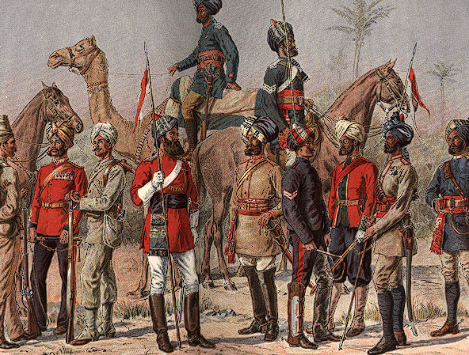
The reorganization of the British Indian Army based on the Peel Commission recommendations formalized the pseudo-scientific theory of “Martial and Non-Martial Races.”
- Martial Races: Castes and communities that had stayed loyal or helped suppress the revolt (e.g., Sikhs, Gurkhas, Pathans, and Punjabi Muslims) were classified as inherently brave and fit for military service.
- Non-Martial Races: Communities that led or participated heavily in the rebellion (e.g., Awadh Brahmins, Rajputs, and the educated Bengalis) were systematically excluded from military recruitment and labeled physically unfit for combat.
The Nationalist and Ideological Legacy
While the revolt was a military failure, its historical memory became a potent tool for ideological mobilization during the 20th-century freedom struggle.
1. Genesis of Anti-Colonial Consciousness
The brutal methods used by the British to suppress the revolt—mass hangings, blowing rebels from canons, and the burning of entire villages—destroyed the myth of a “benevolent British dictatorship.” The sheer scale of British retribution created an underlying current of permanent alienation, making the Indian public receptive to later anti-imperialist ideas.
2. A Symbol of Resistance and Folk Legacies
The leaders of 1857 were romanticized in local folklore, poetry, and literature, keeping the spirit of resistance alive across generations.
- Folk Symbols: The heroism of Rani Laxmibai was immortalized in popular culture, most famously through Subhadra Kumari Chauhan’s poem (“Khoob Ladi Mardani Woh Toh Jhansi Wali Rani Thi”).
- Inspiration for Revolutionaries: Early 20th-century radical nationalists, such as the Ghadar Party, the Hindustan Socialist Republican Association (HSRA), and Subhas Chandra Bose’s Indian National Army (INA), explicitly drew inspiration from the 1857 uprising. Bose named the women’s wing of the INA the Rani of Jhansi Regiment to directly invoke the revolutionary legacy of the 1857 leader.
Summary of Key Shifts (Pre-1857 vs. Post-1857)
| Administrative Area | Pre-1857 Approach | Post-1857 Legacy / Approach |
| Imperial Governance | Administered by a commercial joint-stock entity (East India Company). | Governed directly by the British Crown via the Secretary of State and Viceroy. |
| Territorial Policy | Aggressive annexation and expansion (Doctrine of Lapse, Subsidiary Alliance). | Complete status quo; preservation and patronage of Princely States as loyal allies. |
| Social Policy | Active intervention through progressive Western legal and social reforms. | Strict social conservatism; alignment with orthodox and feudal elements. |
| Military Recruitment | Based primarily on regional proximity within the Bengal, Bombay, and Madras Armies. | Structured around the divisive “Martial vs. Non-Martial Races” theory. |
| Communal Policy | Laissez-faire; general indifference to communal balances. | Active, systemic application of the “Divide and Rule” strategy to stall nationalism. |