
The Qissa Khwani Bazaar Massacre, which took place on April 23, 1930, in Peshawar, is one of the most remarkable and tragic chapters of the Civil Disobedience Movement. It marked the extension of Mahatma Gandhi’s non-violent mass resistance to the strategically sensitive North-West Frontier Province (NWFP). The event demonstrated how deeply the principles of absolute non-violence had taken root among the Pashtun population under the leadership of Khan Abdul Ghaffar Khan, refuting colonial assumptions about the region.
The Context: From Simon Commission to Civil Disobedience
The Political Build-Up
The momentum for mass agitation began with the appointment of the all-British Simon Commission in November 1927. The exclusion of Indian members from this statutory body united fragmented political factions, leading to widespread boycotts and prompting the drafting of the Nehru Report (1928). When the British government ignored the subsequent one-year ultimatum to grant Dominion Status, the Indian National Congress (INC) convened its historic Lahore Session (December 1929) under Jawaharlal Nehru’s presidency, officially declaring Poorna Swaraj (Complete Independence).
The Salt Tax Catalyst
Following Lord Irwin’s rejection of Gandhi’s eleven administrative and economic demands, Gandhi initiated the Civil Disobedience Movement via the Dandi March (March 12 – April 6, 1930). He chose to violate the British salt laws because the state monopoly on salt production heavily penalized the poorest sections of society. On April 6, 1930, Gandhi’s symbolic act of manufacturing salt at Dandi served as a green light for similar protests across British India.
The Rise of the Khudai Khidmatgar
Foundation and Ideology
In November 1929, just prior to the Lahore Congress, Khan Abdul Ghaffar Khan (popularly known as “Frontier Gandhi” or Badshah Khan) founded the Khudai Khidmatgar (Servants of God). Originally a social reform organization, it rapidly transformed into a powerful political movement aligned with the Indian National Congress to resist British colonial rule.
The “Red Shirts”
The volunteers of the movement were popularly known as the Surkh Posh or Red Shirts because they dyed their cotton uniforms with local brick-red clay. Every volunteer took a strict oath pledging absolute allegiance to non-violence, communal harmony, and selfless service to the motherland.
The Flashpoint: April 23, 1930
The Arrests
Following the nationwide launch of the Civil Disobedience Movement, the local administration in the NWFP sought to isolate the province from mainstream agitation. On the morning of April 23, 1930, British authorities arrested Khan Abdul Ghaffar Khan and several other prominent local leaders after they addressed a nationalist gathering in Utmanzai.
The Gathering at Qissa Khwani
News of the arrests traveled quickly, causing large, angry, yet disciplined crowds of Khudai Khidmatgar volunteers and local citizens to converge on the historic Qissa Khwani Bazaar (the “Street of Storytellers”) in Peshawar. The protestors demanded the immediate release of their leaders and completely filled the market square, staging a peaceful sit-in.
The Crackdown
To disperse the dense assembly, the British authorities dispatched armored cars into the crowded marketplace. One of the vehicles struck and killed several protestors, which caused the crowd to surge forward in protest, though they remained unarmed. British officials then ordered troops to open fire on the peaceful assembly with machine guns and rifles.
Key Historical Facts of the Massacre
| Parameter | Historical Details |
| Date of the Event | April 23, 1930 |
| Primary Location | Qissa Khwani Bazaar, Peshawar, NWFP |
| Key Organization | Khudai Khidmatgar (The Red Shirts) |
| Nature of Resistance | Unarmed, absolute non-violence; protestors stood their ground facing gunfire |
| Estimated Casualties | Nationalist sources estimated over 200 to 300 deaths; official British reports admitted to lower figures |
The Royal Garhwal Rifles Incident
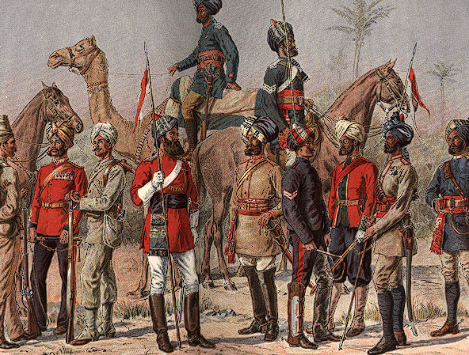
The massacre became a significant turning point in the history of the British Indian Army due to the actions of the 2nd Battalion, 18th Royal Garhwal Rifles. Ordered by their British commanding officers to fire upon the unarmed Pashtun crowd, the Hindu soldiers—led by Havildar Chander Singh Garhwali—refused to pull their triggers. They declared that they would not shoot their unarmed, non-violent fellow countrymen. The platoon was immediately disarmed, arrested, and subjected to a strict military court-martial, with its members receiving long terms of rigorous imprisonment. This incident highlighted the potential for nationalist ideas to spread within the ranks of the colonial military.
Impact on the Civil Disobedience Movement
Expansion of the Movement
The Qissa Khwani Bazaar Massacre failed to suppress the agitation in the frontier region. Instead, it generated a massive wave of public sympathy. Within months, membership in the Khudai Khidmatgar swelled from a few thousand to over 80,000 disciplined volunteers.
Alternative Regional Tactics
Because the landlocked North-West Frontier Province did not have access to sea salt to violate the salt laws, the Khudai Khidmatgars adapted the Civil Disobedience Movement to their geography through alternate methods:
- No-Tax Campaigns: Total refusal to pay agricultural land revenues and water rates to the colonial government.
- Picketing: Highly effective, continuous picketing of liquor stores and shops selling foreign cloth in urban trade hubs.
- Boycott of State Institutions: Massive resignations of village officials and headmen from government service.
Ideological Significance
The events at Peshawar demonstrated that Gandhian non-violence could be adopted by communities with deep martial traditions. The strict adherence of the Red Shirts to non-violence under fire challenged colonial justifications for the use of military force in the province. The strategic vulnerability of a mass uprising on the borders of British India forced the colonial state to divert significant military resources to maintain administrative control, contributing to the pressure that eventually led to the Gandhi-Irwin Pact of March 5, 1931.
Last Modified: June 12, 2026