

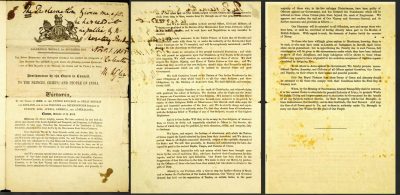
The Government of India Act 1858, formally titled “An Act for the Better Government of India,” was enacted by the British Parliament on August 2, 1858. This legislation was a direct consequence of the Revolt of 1857 (often termed the Sepoy Mutiny or the First War of Indian Independence), which exposed the military and administrative vulnerabilities of the East India Company. British policymakers realized that managing a vast empire through a private mercantile corporation was no longer viable. Consequently, the Act terminated the Company’s rule and brought India under the direct sovereignty of the British Crown, initiated under the premiership of Lord Palmerston and completed under Lord Derby.
Core Provisions and Constitutional Changes
Liquidation of the East India Company and Transfer of Power
The Act stripped the East India Company of all its political and territorial powers over India.
- Crown Sovereignty: The governance of India was transferred directly to Her Majesty Queen Victoria. All territories, revenues, and naval/military forces of the Company were vested in the British Crown.
- Declaration of Trust: The Act declared that India would be governed by and in the name of the Sovereign, ending the dual and highly criticized commercial-political hybrid administration.
Abolition of the Dual Government System
The Act dismantled the complex “Double Government” structure that had been established by Pitt’s India Act of 1784.
- Dissolution of Existing Bodies: Both the Court of Directors (representing the East India Company shareholders) and the Board of Control (representing the British Parliament) were abolished.
- Consolidation of Powers: All powers previously exercised by these two bodies were concentrated into a single, unified office within the British Cabinet.
Creation of the Office of the Secretary of State for India
To exercise the Crown’s authority over Indian administration, a new constitutional post was created in the British Cabinet.
- Constitutional Status: The Secretary of State for India (SoS) was a member of the British Parliament and a Cabinet Minister. Therefore, the SoS was directly responsible and accountable to the British Parliament.
- Financial Control: The SoS was given absolute control over the revenues and expenditure of India, and no expenditure from Indian revenues could be sanctioned without the concurrence of the SoS.
- First Incumbent: Lord Stanley was appointed as the first Secretary of State for India.
Establishment of the Council of India
To assist and advise the Secretary of State, an advisory body called the Council of India was established in London.
- Composition: The Council consisted of 15 members. To ensure administrative continuity, 8 members were appointed by the Crown and 7 were elected by the outgoing Court of Directors.
- Mandate for Indian Experience: The Act mandated that at least 9 of these 15 members must have served or resided in India for at least ten years and must not have left India more than ten years before their appointment.
- Nature of the Council: The Council was primarily an advisory body. The Secretary of State held veto power over the majority of the Council’s decisions, except in matters relating to the expenditure of Indian revenues, where a majority vote of the Council was binding.
- Corporate Status: The Council of India was a body corporate that could sue and be sued both in India and in England.
Re-designation of the Head of Executive: The Viceroy
The title and role of the supreme executive authority inside India underwent a significant constitutional change.
- The Dual Role: The Governor-General of India was given the additional title of Viceroy of India. As Governor-General, he remained the head of the administration inside India; as Viceroy, he acted as the direct personal representative of the British Crown to the Indian Princely States.
- First Incumbent: Lord Canning, who was the Governor-General during the Revolt of 1857, became the first Viceroy of India.
Structural Comparison of Administration
| Administrative Feature | Before the Act of 1858 (Company Rule) | After the Act of 1858 (Crown Rule) |
|---|---|---|
| Sovereign Authority | East India Company (in trust for the Crown) | The British Crown (Direct Rule) |
| Home Government Mechanism | Dual Control: Board of Control & Court of Directors | Secretary of State for India assisted by the 15-member Council of India |
| Head of Executive in India | Governor-General of India | Governor-General and Viceroy of India |
| Accountability Focus | Company Shareholders and periodic Parliamentary Review | Direct and continuous accountability to the British Parliament via a Cabinet Minister |
| Policy toward Princely States | Aggressive annexation (e.g., Doctrine of Lapse) | Status quo, preservation of treaties, and abandonment of annexation policies |
Civil Service and Military Reorganization
Institutionalization of Open Competition
The Act preserved the open competitive examination system for the Indian Civil Service (ICS) that had been introduced by the Charter Act of 1853. The power to frame rules and regulations for these examinations was transferred from the Company to the Secretary of State in Council, acting in consultation with the Civil Service Commissioners in London.
Restructuring of the Military Forces
The Act transferred the entire military establishment of the East India Company to the service of the Crown. This led to the structural reorganization of the Indian Army based on the recommendations of the Peel Commission (1859). The ratio of European to Indian soldiers was significantly increased, and key strategic positions like artillery were strictly reserved for European troops to prevent future insurrections.
The Queen’s Proclamation of 1858
On November 1, 1858, Lord Canning held a grand Durbar at Allahabad where he read out Queen Victoria’s Proclamation to the princes and people of India. While not a statutory part of the Act itself, this proclamation served as the policy manifesto of the new Crown regime.
- End of Annexation: It announced the formal abandonment of the aggressive policy of territorial annexation, effectively nullifying Lord Dalhousie’s contentious Doctrine of Lapse.
- Respect for Treaties: The Crown promised to scrupulously respect the treaties, rights, dignity, and honor of the native Indian Princely States.
- Religious Non-Interference: The British government pledged strict neutrality and non-interference in the religious beliefs, social customs, and traditional practices of the Indian people.
- General Amnesty: A general amnesty was granted to all rebels who had participated in the Revolt of 1857, provided they were not directly involved in the murder of British subjects.
Analytical Limitations of the Act
While the Act effected a massive structural overhaul in the home government in London, it brought minimal change to the administrative machinery operating within India.
- Unchecked Centralization: The domestic administration remained absolute, highly centralized, and completely bureaucratic, with no institutional representation or legislative role given to Indians.
- Dictatorial Executive: The Viceroy and his Executive Council continued to exercise sweeping authoritarian powers over the subcontinent, merely changing the authority in whose name they ruled.
Prelims-Oriented Trivia and Facts
The Act for the Better Government of India
The official legal nomenclature of the Government of India Act 1858 in British constitutional law text is 21 & 22 Vict. c. 106.
Lord Stanley’s Unique Position
Lord Stanley, who became the first Secretary of State for India under this Act, had previously served as the last President of the Board of Control, ensuring a smooth transition of institutional memory from the Company to the Crown.
The Indian Council’s Financial Veto
Although the Secretary of State could override his Council on most administrative policies, the Act deliberately made him subservient to a majority vote of the Council on any issue involving the spending of Indian revenues, serving as an internal audit mechanism.
Transfer of Debt
Under the provisions of the Act, the massive public debt accumulated by the East India Company during its military conquests and the suppression of the 1857 revolt was transferred directly onto the Indian exchequer, placing a heavy financial burden on Indian taxpayers from the very inception of Crown Rule.
Last Modified: June 13, 2026